


BÙI THỊ THANH XUÂN
Giới thiệu về bản thân


Dear Sir or Madam,
I am writing to enquire about the cooking course in your advertisement. I am very interested in improving my cooking skills and would like to receive more detailed information about this course.
First, I would like to know the duration of the course and the starting dates available. I also wonder whether any certificates or qualifications are required to enrol and what level of experience or professional skills participants should have. In addition, I would appreciate it if you could provide detailed information about the course fees and whether the materials and ingredients are included in the price.
Furthermore, could you please inform me about the instructors’ qualifications and whether students will be trained by experienced and highly skilled chefs? Finally, I would be grateful if you could tell me about any job opportunities or career support available after completing the course.
I look forward to receiving your reply.
Yours, faithfully,
Xuan.
a. Độ dãn của lò xo khi hệ cân bằng:
Áp dụng định luật Hooke ở trạng thái cân bằng:
\(F_{đℎ}=P\Rightarrow k\cdot\Delta l=m\cdot g\)
\(\Delta l=\frac{m\cdot g}{k}=\frac{0 , 5 \cdot9 , 8}{100}=\frac{4 , 9}{100}=0,049\text{m}=4,9\text{cm}\)
b. Lò xo có độ dãn cực đại là 10 cm → biên độ là phần dao động thêm so với vị trí cân bằng.
\(A=10\text{cm}-4,9\text{cm}=5,1\text{cm}\)
c. Độ dãn tổng cộng:
\(\Delta l=4,9\text{cm}+6\text{cm}=10,9\text{cm}=0,109\text{m}\)
Lực kéo:
\(F=k\cdot\Delta l=100\cdot0,109=10,9\text{N}\)
a. \(r\) = 150 triệu km = 150.109 m
\(T_1\) = 365,25 ngày
\(w_1=\frac{2\pi}{T_1}=2.10^{-7}\) rad/s
\(v_1=w_1\left(\right.r+R\left.\right)=30001\) m/s
b. \(R\) = 6400 km = 6400.103 m
\(T_2\) = 24 giờ
\(T_2=\frac{2\pi}{T_2}=7,27.10^{-5}\) rad/s
\(v_2=w_2R=465\) m/s
c. \(R=6400.cos30^0=\frac{6400. \sqrt{3}}{2}\) m
\(T_3\) = 24 giờ
\(w_3=\frac{2\pi}{T_3}=7,27.10^{-5}\) rad/s
\(v_3=w_3R=402\) m/s
Coi hệ gồm hai viên bi là một hệ kín.
Theo định luật bảo toàn động lượng ta có:
\(\overset{\rightarrow}{p_1}+\overset{\rightarrow}{p_2}=\overset{\rightarrow}{p}\) hay \(m_1\left(\overset{\rightarrow}{\text{v}}\right)_1+m_2\left(\overset{\rightarrow}{\text{v}}\right)_2=\left(\right.m_1+m_2\left.\right)\overset{\rightarrow}{\text{v}}\)
a. Sau va chạm chúng dính vào nhau và chuyển động với vận tốc \(\text{v}\) = 3m/s theo hướng chuyển động ban đầu của viên bi 1.
Chọn chiều dương là chiều chuyển động của bi 1, bi 2 ban đầu.
Ta có: \(m_1\text{v}_1+m_2\text{v}_2=\left(\right.m_1+m_2\left.\right)\text{v}\)
\(\Rightarrow\text{v}_2=\frac{\left(\right.m_1+m_2\left.\right)\text{v}-m_1\text{v}_1}{m_2}=\frac{\left(\right. 0 , 5 + 0 , 3 \left.\right) . 3 - 0 , 5.4}{0 , 3}=1,33\) m/s
b. Sau va chạm chúng dính vào nhau và chuyển động động với vận tốc \(\text{v}\) = 3 m/s theo hướng vuông góc với hướng chuyển động ban đầu của viên bi 1.
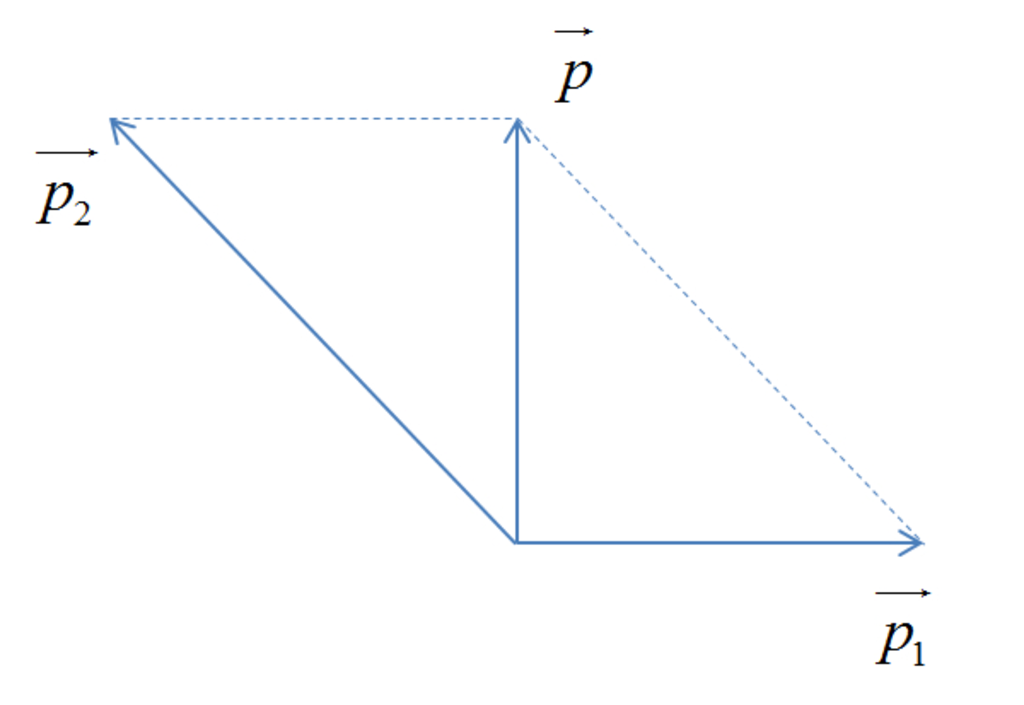
Từ hình vẽ ta suy ra: \(p_2=\sqrt{p^2+p_1^2}\)
\(p=\left(\right.m_1+m_2\left.\right)\text{v}=\left(\right.0,5+0,3\left.\right).3=2,4\) kg.m/s
\(p_1=m_1\text{v}_1=0,5.4=2\) kg.m/s
\(\Rightarrow m_2=3,12\) kg.m/s
\(\text{v}_2=\frac{p_2}{v_2}=\frac{3 , 12}{0 , 3}=10,4\) m/s