


TRẦN NGỌC THÙY TRANG
Giới thiệu về bản thân


Dear Sir or Madam,
I am writing to request more information about the tour guide training course advertised by SGV Vocational School. I am very interested in becoming a tour guide because I enjoy traveling and learning about different cultures.
First, I would like to know more about the course duration and the starting dates. Could you please tell me how long the training program lasts and how often new course begin? In addition, I wonder what subjects are included in the course and whether students receive practical training during the apprenticeship.
I would also appreciate it if you could provide information about the course fees and any additional costs. Furthermore, I would like to know if accommodation or job support is available after completing the course.
I look forward to receiving your reply soon. Thank you for your time and assistance.
Yours faithfully,
Tran Ngoc Thuy Trang
Fđh=P⇒k⋅Δl=m⋅g
\(\Delta l=\frac{m \cdot g}{k}=\frac{0 , 5 \cdot9 , 8}{100}=\frac{4 , 9}{100}=0,049\text{m}=4,9\text{cm}\)
b. Lò xo có độ dãn cực đại là 10 cm → biên độ là phần dao động thêm so với vị trí cân bằng.
\(A=10\text{cm}-4,9\text{cm}=5,1\text{cm}\)
c. Độ dãn tổng cộng:
\(\Delta l=4,9\text{cm}+6\text{cm}=10,9\text{cm}=0,109\text{m}\)
Lực kéo:
\(F=k\cdot\Delta l=100\cdot0,109=10,9\text{N}\)
a. \(r\) = 150 triệu km = 150.109 m
\(T_{1}\) = 365,25 ngày
\(\omega_{1} = \frac{2 \pi}{T_{1}} = 2.1 0^{- 7}\) rad/s
\(v_{1} = \omega_{1} \left(\right. r + R \left.\right) = 30001\) m/s
b. \(R\) = 6400 km = 6400.103 m
\(T_{2}\) = 24 giờ
\(\omega_{2} = \frac{2 \pi}{T_{2}} = 7 , 27.1 0^{- 5}\) rad/s
\(v_{2} = \omega_{2} R = 465\) m/s
c. \(R = 6400. cos 3 0^{0} = \frac{6400. \sqrt{3}}{2}\) m
\(T_{3}\) = 24 giờ
\(\omega_{3} = \frac{2 \pi}{T_{3}} = 7 , 27.1 0^{- 5}\) rad/s
\(v_{3} = \omega_{3} R = 402\) m/s
Coi hệ gồm hai viên bi là một hệ kín.
Theo định luật bảo toàn động lượng ta có:
\(\overset{\rightarrow}{p_{1}} + \overset{\rightarrow}{p_{2}} = \overset{\rightarrow}{p}\) hay \(m_{1} \left(\overset{\rightarrow}{\text{v}}\right)_{1} + m_{2} \left(\overset{\rightarrow}{\text{v}}\right)_{2} = \left(\right. m_{1} + m_{2} \left.\right) \overset{\rightarrow}{\text{v}}\)
a. Sau va chạm chúng dính vào nhau và chuyển động với vận tốc \(\text{v}\) = 3m/s theo hướng chuyển động ban đầu của viên bi 1.
Chọn chiều dương là chiều chuyển động của bi 1, bi 2 ban đầu.
Ta có: \(m_{1} \text{v}_{1} + m_{2} \text{v}_{2} = \left(\right. m_{1} + m_{2} \left.\right) \text{v}\)
\(\Rightarrow \text{v}_{2} = \frac{\left(\right. m_{1} + m_{2} \left.\right) \text{v} - m_{1} \text{v}_{1}}{m_{2}} = \frac{\left(\right. 0 , 5 + 0 , 3 \left.\right) . 3 - 0 , 5.4}{0 , 3} = 1 , 33\) m/s
b. Sau va chạm chúng dính vào nhau và chuyển động động với vận tốc \(\text{v}\) = 3 m/s theo hướng vuông góc với hướng chuyển động ban đầu của viên bi 1.
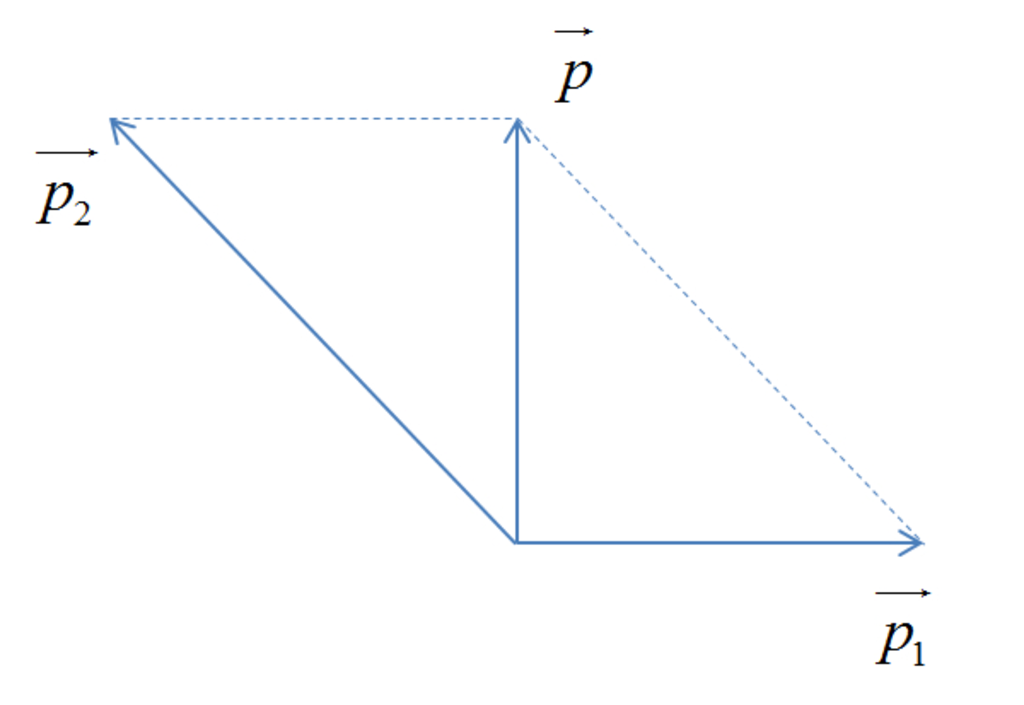
Từ hình vẽ ta suy ra: \(p_{2} = \sqrt{p^{2} + p_{1}^{2}}\)
\(p = \left(\right. m_{1} + m_{2} \left.\right) \text{v} = \left(\right. 0 , 5 + 0 , 3 \left.\right) . 3 = 2 , 4\) kg.m/s
\(p_{1} = m_{1} \text{v}_{1} = 0 , 5.4 = 2\) kg.m/s
\(\Rightarrow p_{2} = 3 , 12\) kg.m/s
\(\text{v}_{2} = \frac{p_{2}}{m_{2}} = \frac{3 , 12}{0 , 3} = 10 , 4\) m/s