Rewrite the sentences using the given words in the brackets. (0.4 point)
1. It's a good idea for students to use online resources for learning. (should)
2. She didn’t speak English well, but she traveled alone to the UK. (Although)

Hãy nhập câu hỏi của bạn vào đây, nếu là tài khoản VIP, bạn sẽ được ưu tiên trả lời.
1. Từ chỉ số lượng:
Ex: She has lots of / many books.
There is a lot of / much water in the glass.
2. Câu so sánh:
a. So sánh hơn:
b. So sánh nhất:
c. Một số từ so sánh bất qui tắc:
3. Từ nghi vấn:
4. Thì
Thì | Cách dùng | Dấu hiệu | Ví dụ |
| SIMPLE PRESENT (Hiện tại đơn)
– To be: thì, là, ở KĐ: S + am / is / are | – chỉ một thói quen ở hiện tại – chỉ một sự thật, một chân lí. | – always, usually, often, sometimes, seldom, rarely (ít khi), seldom(hiếm khi),every, once(một lần), | – She oftengets up at 6 am. – The sun risesin the east. (Mặt trời mọc ở hướng Đông) |
| PĐ: S + am / is / are + not NV: Am / Is / Are + S …? – Động từ thường: KĐ: S + V1 / V(s/es) PĐ: S + don’t/ doesn’t + V1 NV: Do / Does + S + V1 …? | twice (hai lần) | ||
| PRESENT CONTINUOUS (Hiện tại tiếp diễn) KĐ: S + am / is / are + V-ing PĐ: S + am / is / are + not + V-ing
NV: Am / Is /Are + S + V-ing? | – hành động đang diễn ra ở hiện tại. | – at the moment, now, right now, at present – Look! Nhìn kìa – Listen! Lắng nghe kìa | – Now, we are learning English. – She is cookingat the moment. |
| SIMPLE PAST (Quá khứ đơn)
– To be: KĐ: I / He / She / It + was You / We / They + were PĐ: S + wasn’t / weren’t NV: Was / were + S …?
– Động từ thường: KĐ: S + V2 / V-ed PĐ: S + didn’t + V1 NV: Did + S + V1 ….? | – hành động xảy ra và chấm dứt trong quá khứ. | – yesterday, last week, last month, …ago, in 1990, in the past, … | – She went to London last year. – Yesterday, hewalked to school. |
| SIMPLE FUTURE (Tương lai đơn)
KĐ: S + will / shall + V1 I will = I’ll PĐ: S + will / shall + not + V1 (won’t / shan’t + V1)
NV: Will / Shall + S + V1 …? | – hành động sẽ xảy ra trong tương lai | – tomorrow(ngày mai), next, in 2015, tonight (tối nay), soon(sớm) …. | – He will comeback tomorrow. – We won’t goto school next Sunday. |
* Một số động từ bất qui tắc khi chia quá khứ đơn:
Nguyên mẫu | Quá khứ | Nghĩa |
| – be | – was / were | – thì, là, ở |
| – go | – went | – đi |
| – do | – did | – làm |
| – have | – had | – có |
| – see | – saw | – nhìn thấy |
| – give | – gave | – cho |
| – take | – took | – lấy |
| – teach | – taught | – dạy |
| – eat | – ate | – eaten |
| – send | – sent | – gửi |
| – teach | – taught | – dạy |
| – think | – thought | – nghĩ |
| – buy | – bought | – mua |
| – cut | – cut | – cắt, chặt |
| – make | – made | – làm |
| – drink | – drank | – uống |
| – get | – got | – có, lấy |
| – put | – put | – đặt, để |
| – tell | – told | – kể, bảo |
| – little | – less | – ít hơn |
5. Số thứ tự:
| – first | – eleventh | – twenty-first |
| – second | – twelfth | – twenty-second |
| – third | – thirteenth | – twenty-third |
| – fourth | – fourteenth | – twenty-fourth |
| – fifth | – fifteenth | – twenty-fifth |
| – sixth | – sixteen | – …………… |
| – seventh | – seventeenth | – ………….. |
| – eighth | – eighteenth | – ………….. |
| – ninth | – nineteenth | – ………….. |
| – tenth | – twentieth | – thirtieth |
6. Câu cảm thán:
What + a / an + adj + N!
Ex:
What a beautiful house!
What an expensive car!
7. Giới từ
chỉ nơi chốn:
on – next to
in (tỉnh, thành phố) – behind
under – in front of
near (gần) – beside (bên cạnh)
to the left / the right of – between
on the left (bên trái) – on the right (bên phải)
at the back of (ở cuối …) – opposite
on + tên đường
at + số nhà, tên đường
chỉ thời gian:
at + giờ – in + tháng, mùa, năm
on + thứ, ngày – from …to
after (sau khi) – before (trước khi)
Ex: at 6 o’clock
in the morning / in the afternoon / in the evening in August, in the autumn, in 2012
on Sunday, on 20th July from Monday to Saturday
chỉ phương tiện giao thông:
by; on
Ex: by car; by train, by plane
on foot.
8. Câu đề nghị:
Ex: What about watching TV?
Câu trả lời:
– Good idea. / Great (tuyệt) / OK / – I’d love to.
– I’m sorry, I can’t.
Ex: Let’s go to the cinema.
Should we play football?
Would you to go swimming?
9. Lời hướng dẫn (chỉ đường):
Ex:
– Excuse me. Could you show me the way to the supermarket, please?
– OK. Go straight ahead. Take the first street on the right. The supermarket is in front of you
10. Hỏi giờ :
What time is it?
What’s the time?
Do you have the time?
11. Mất bao lâu để làm gì:
How long does it take + (O) + to V => It takes + (O) + thời gian + to V…
Ex: How long does it take you to do this homework?
12. Hỏi về khoảng cach:
How far is it from ………………to ……………?
=> It’s about + khoảng cách
13. Cách nói ngày tháng :
Tháng + ngày
Hoặc the + ngày + of + tháng
Ex: May 8th
the 8th of May
14. Have fun + V_ing : Làm việc gì một cách vui vẻ
15. Hỏi giá tiền :
How much + is / are + S ? => S + is / are + giá tiền
How much + do /does + S + cost ? => S + cost(s) + giá tiền
16. Tính từ kép:
Số đếm...
1. Từ chỉ số lượng:
Ex: She has lots of / many books.
There is a lot of / much water in the glass.
2. Câu so sánh:
a. So sánh hơn:
b. So sánh nhất:
c. Một số từ so sánh bất qui tắc:
3. Từ nghi vấn:
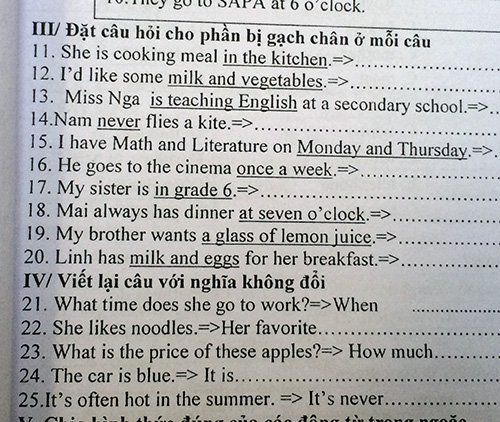
III
1, Where is she cooking meal
2, What would you like
3, What is Miss Lan doing at the secondnary school
4, How often does Nam fly kite
5, When you have Math and Literature
6, How often does he go to the cinema
7, What is your grade of your sister
8, What time does Mai always have dinner
9, What does your brother want
10, What does Linh have for her breakfast
SGK Tiếng Anh lớp 5 Mới Unit 8: What Are You Reading?
Ngữ pháp Unit 8 SGK tiếng Anh lớp 5 mới
Khi chúng ta muốn hỏi về tính cách của một nhân vạt nào đó trong truyện, chúng ta sẽ sử dụng mẫu câu: What’s she/he ?
1. Ôn tập cách thành lập thì hiện tại tiếp diễn
Thể | Chủ ngữ (S) | Động từ (V) | Ví dụ |
Khẳng định | I | am + V-ing | I am learning English. |
He/She/lt/danh từ số ít | is + v-ing | She is learning English. He is learning English. | |
You/We/They/ danh từ số nhiều | are + V-ing | They are learning English. We are learning English. | |
Phủ định | I | am not + V-ing | I am not learning English. |
He/She/lt/danh từ số ít | is not + V-ing | She is not learning English. He is not learning English. | |
You/We/They/ danh từ số nhiều | are not + V-ing | They are not learning English. We are not learning English. | |
Nghi vấn | Am I | + V-ing...? | Am I learning English? |
Is he/she/it/danh từ số ít | + v-ing...? | Is she learning English? Is he learning English? | |
Are you/we/they/ danh từ số nhiều | + V-ing...? | Are they learning English? Are we learning English? |
2. Hỏi đáp về hoạt động đang diễn ra vào thời điểm được nói tới:
Ex: What are you reading?
(Bạn đang đọc gì vậy?)
I'm reading a ghost story.
(Tôi đang một câu chuyện ma.)
3. Hỏi đáp về ai đó đang đọc sách gì
Nếu chúng ta muốn hỏi ai đó đang đọc sách gì, chúng ta sẽ sử dụng các mẫu câu sau:
(1) What book are you/they reading? (Bạn/Họ đang đọc sách gì?)
I’m/They’re reading The Legend of Hoan Kiem Lake.
(Tôi/Họ đang đọc “Sự tích Hồ Hoàn Kiếm")
(2) What book is she/he reading? (Cô/Cậu ấy đang đọc sách gì?)
She/He is reading The Legend of Hoan Kiem Lake.
(Cô/Cậu ấy đang đọc "Sự tích Hồ Hoàn Kiếm".)
4. Hỏi đáp tính cách của ai đó trong truyện
Khi chúng ta muốn hỏi về tính cách của một nhân vật nào đó trong truyện, chúng ta sẽ sử dụng mẫu câu:
What’s she/he ? (Cô/Cậu ấy như thế nào?)
=> She/He is... (Cô/Cậu ấy...)
Ex: What is he ? (Cậu ấy như thế nào?)
He's brave. (Cậu ấy dũng cảm.)
5. Hỏi đáp về muốn mượn ai cái gì đó
Khi muốn xin phép mượn ai đó cái gì đó, chúng ta có thể sử dụng cấu trúc sau:
May I borrow + ..? (Cho tôi mượn... được không ạ? / Có thể cho tôi mượn ... không ạ?)
=> Yes, you can. (Vâng, bạn có thể.)
=> No, you can’t. (Không, bạn không có thể.)
Lưu ý: can’t là viết tắt của cannot.
Ex: May I borrow the book? (Cho tôi mượn quyển sách được không ạ?)
Yes, you can. (Vâng, bạn có thể.)
1. It takes sb khoảng thời gian to do sth= sb spend khoảng thời gian doing sth
VD: It took her 3 hours to get to the city centre.
= She spent 3 hours getting to the city centre.
2. Understand = tobe aware of
VD: Do you understand the grammar structure?
= Are you aware of the grammar structure?
3. = tobe interested in = enjoy = keen on
VD: She s polis
= She is interested in polis
4. Because + clause = because of + N
VD: He can’t move because his leg was broken
= He can’t move because of his broken leg
5. Although + clause = despite + N = in spite of + N
VD: Although she is old, she can compute very fast
= Despite/ In spite of her old age, she can compute very fast
6. Succeed in doing sth = manage to do sth
VD: We succeeded in digging the Panama cannel
= We managed to dig the Panama cannel
7. Cấu trúc: …..too + adj (for sb) to do sth: quá để làm gì
VD: My father is too old to drive.
= It is such a/ an N that: quá đến nỗi mà
VD: She is so beautiful that everybody loves her.
= It is such a beautiful girl that everybody loves her.
Adj/ Adv + enough (for sb) to do sth: đủ để làm gì
VD: This car is safe enough for him to drive
VD: The policeman ran quickly enough to catch the robber
8. Cấu trúc: prefer sb to do sth = would rather sb Vpast sth: thích, muốn ai làm gì
VD: I’prefer you (not) to smoke here
= I’d rather you (not) smoked here
9. Prefer doing sth to doing sth: thích làm gì hơn làm gì
Would rather do sth than do sth
VD: She prefers staying at home to going out
= She’d rather stay at home than go out
10. Can = tobe able to = tobe possible
11. Harly + had +S + Vpp when S + Vpast: ngay sau khi... thì…
No sooner + had +S + Vpp than S + Vpast
VD: As soon as I left the house, he appeared
= Harly had I left the house when he appeared
= No sooner had I left the house than he appeared
12. Not………..any more: không còn nữa
No longer + dạng đảo ngữ S no more V
VD: I don’t live in the courtryside anymore
= No longer do I live in the coutryside
= I no more live in the coutryside
13. At no time + dạng đảo ngữ: không khi nào, chẳng khi nào
VD: I don’t think she loves me
= At no time do I think she loves me
14. Tobe not worth = there is no point in doing sth: không đáng làm gì
15. Tobe not worth doing sth = there is no point in doing sth: không đáng, vô ích làm gì
VD: It’s not worth making him get up early
= There is no point in making him getting early
16. It seems that = it appears that = it is ly that =it look as if/ as though: dường như rằng VD: It seems that he will come late
= It appears that/ it is ly he will come late
= He is ly to come late.
= It look as if he will come late
17. Although + clause = Despite + Nound/ gerund
18. S + V + N = S + be + adj
19. S + be + adj = S + V + O
20. S + be accustomed to + Ving = S + be used to +Ving/ N
21. S + often + V = S + be used to +Ving/ N
VD: Nana often cried when she meets with difficulties.
= Nana is used to crying when she meets with difficulties
22. This is the first time + S + have + PII = S+be + not used to + Ving/ N
VD: This is the first time I have seen so many people crying at the end of the movie.
= I was not used to seeing so many people crying at the end of the movie.
23. S + would prefer = S + would rather S + Past subjunctive (lối cầu khẩn)
24. S + sth/ doing sth better than sth/ doing sth = S + would rather + V + than + V = S + prefer sth/ doing sth to sth/ doing sth...
VD: I prefer going shoping to playing volleyball.
= I would rather go shoping than play volleyball.
26. S + V + O = S + find + it (unreal objective) + adj + to + V
27. It’s one’s duty to do sth = S + be + supposed to do sth
28. S + be + PII + to + V = S + be + supposed to do sth
29. Imperative verb (mệnh lệnh) = S + should (not) + ...
\(\rarr\)
1. Students should use online resources for learning.
2. Although she didn’t speak English well, she traveled alone to the UK.
1.Students should use online resources for learning.
2.She traveled alone to the UK although she didn't speak English well