
Hoa:thank you so much for helping me with that work
Long:............................................
A.i'm sorry B.Good idea C.You're welcome D.That's right
Hãy nhập câu hỏi của bạn vào đây, nếu là tài khoản VIP, bạn sẽ được ưu tiên trả lời.

Studying English language in an English - speaking country has many advantages. Howver, I believe that it is not the best way to learn the language.
Firstly, most students who live in non - English - speaking countries learn English at secondary schooland at university.Although their spoken is not fluent, their knowledge of grammar is often quite advanced. This is useful when they come to an English - speaking country to improve the language.
Secondly, students'living at home do not have to worry about problems such as: finding accommodation, paying for their study, living costs and trying to survive in a foreign country. It would cause them much stress.
Finally, nowadays, the society is grower and grower and information technology is also improved. The internet thus also born. So we can register a few courses on the network. It also helps us to speak and communicate with English speakers.
For the reasons above, I believe that we can learn English whenever and wherever nowadays.
Tham khaor nha !
Learning the English language in a country where people speak English is a very advantageous option, although not the only way. Personally, I completely agree with this statement, because living in English spoken country has a lot of benefits in terms of mastering this language.
Learning English is easier in an English-speaking country because the people around you are speaking English and makes it easy to adjust to English accent and also sentence patterns. For instance, it is very hard to learn English accent without listening to English. Besides living in English speaking country will enrich your vocabulary and grammar and that enhancement will occur spontaneously. And you can ask anything about the language that you have doubts about. You are bound to speak in this language and that would give you an excellent opportunity to enhance your speaking skill.
On the other hand, it is not the only way to learn a language. There are a lot of books that you can utilise. English radio programmes or TV shows are best options to learn the language. So, it will help you increasing your listening skills. In addition, nowadays, the internet is widespread and also a superiority in our world. Thereby, the internet comprises all kind of information and it will help you about your doubts. It is evident that there are enough programmes for speaking with somebody in which it will improve your speaking skills.
I would agree that people who live in a country like Canada, USA, UK or Australia, where English is used as the primary way of communication, would help them master this language pretty quickly and accurately. But not always you need to live there to learn this language. It is not uncommon for people who have never been in an English speaking country to have an excellent command over this language. Some of the poets and writers who wrote successful English literature have been born and raised and lived in non-English- speaking countries.
To sum up, learning English in an English spoken language will make it easy to study but there are a lot of ways that can be used for learning this language.
Some people learn a second language (1) easily. Other people have trouble learning a new language. How can you have (2) yourselves learn a new language, such as English ? There are several ways to make learning English a little (3) easier and more interesting. The first step is to feel positive about learning English. If you believe that you can learn, you will learn (4) be patient. You do not to have to understand (5) everything all at once. It's natural to make mistakes when you learn something new. We can learn from our mistakes. The second step is to practice your English. For example, write in a journal, or diary, every day. You will get used to (6) using in English, and you will feel comfortable expressing your ideas in English. After several weeks, you will see that your writing is improving. (7) In addition, you much speak English every day, You can practice with your classmates (8) outside class. The third step is to keep a record of your language learning. You can write this in your journal. After (9) each class, think about what you did. Did your answer a question (10) correctly ? Did you understand something the teacher explained ? Perharps the lesson was difficult, but you tried to understand it. It is important to practice every day and make a record of your achievements.
Bạn có hai lỗi sai:
1. ô số (4) phải là to be patient
2. ô số (5) phải là anything (vì câu đó là phủ định)
Tham khảo
1. A: B, why are you so sad?
B: I have a friend who lives in a mountainous area. A landslide destroyed his family's garden yesterday.
A: I’m sory to hear that.
2. A: B, why are you so sad?
B: The news says that a big earthquake hit the city.
A: That’s awful. I hope everyone is safe.
1.
A: Hi, I'm a bit nervous about the upcoming exam.
(Xin chào, tôi hơi lo lắng về kỳ thi sắp tới.)
B: Don't worry, you got this! I know you've been studying hard and you're well-prepared. Good luck!
(Đừng lo lắng, bạn đã có cái này! Tôi biết bạn đã học tập chăm chỉ và bạn đã chuẩn bị tốt. Chúc may mắn!)
A: Thank you! I really appreciate your support.
(Cảm ơn bạn! Tôi thực sự đánh giá cao sự hỗ trợ của bạn.)
B: No problem at all. Just do your best and everything will work out.
(Không có vấn đề gì cả. Chỉ cần cố gắng hết sức rồi mọi việc sẽ ổn thôi.)
2.
A: Hey, how are you feeling today?
(Này, hôm nay bạn cảm thấy thế nào?)
B: Not too great, I'm feeling a bit sick.
(Không tốt lắm, tôi cảm thấy hơi ốm.)
A: I'm sorry to hear that. I hope you feel better soon.
(Tôi rất tiếc khi nghe điều đó. Tôi hy vọng bạn sẽ sớm cảm thấy tốt hơn.)
B: Thanks, I appreciate it.
(Cảm ơn, tôi đánh giá cao nó.)
A: Is there anything I can do to help?
(Tôi có thể giúp gì được không?)
B: Just your kind words and good wishes are enough to make me feel better. Thank you.
(Chỉ cần những lời tốt đẹp và lời chúc tốt đẹp của bạn là đủ để làm cho tôi cảm thấy tốt hơn. Cảm ơn.)
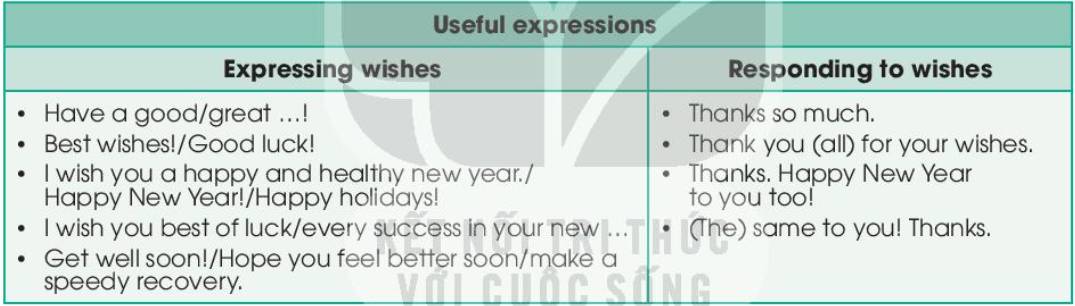
Đáp án C phải ko
Đáp án đúng là: C. You're welcome
Giải thích:
Khi ai đó nói "Thank you", cách trả lời lịch sự là "You're welcome" (Không có gì / Không sao).
Các lựa chọn khác không phù hợp trong ngữ cảnh này.