
Tìm x để 1-x/2-x=2/3
Hãy nhập câu hỏi của bạn vào đây, nếu là tài khoản VIP, bạn sẽ được ưu tiên trả lời.

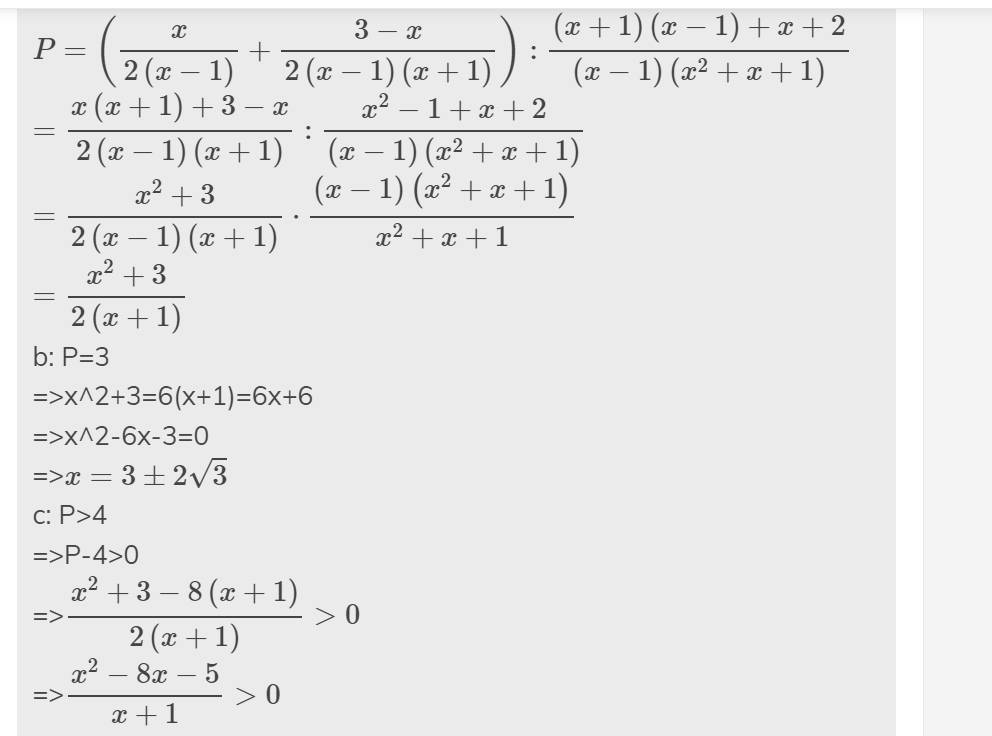
a: Sửa đề: \(P=\left(\dfrac{x}{2x-2}+\dfrac{3-x}{2x^2-2}\right):\left(\dfrac{x+1}{x^2+x+1}+\dfrac{x+2}{x^3-1}\right)\)\(P=\left(\dfrac{x}{2\left(x-1\right)}+\dfrac{3-x}{2\left(x-1\right)\left(x+1\right)}\right):\dfrac{\left(x+1\right)\left(x-1\right)+x+2}{\left(x-1\right)\left(x^2+x+1\right)}\)
\(=\dfrac{x\left(x+1\right)+3-x}{2\left(x-1\right)\left(x+1\right)}:\dfrac{x^2-1+x+2}{\left(x-1\right)\left(x^2+x+1\right)}\)
\(=\dfrac{x^2+3}{2\left(x-1\right)\left(x+1\right)}\cdot\dfrac{\left(x-1\right)\left(x^2+x+1\right)}{x^2+x+1}\)
\(=\dfrac{x^2+3}{2\left(x+1\right)}\)
b: P=3
=>x^2+3=6(x+1)=6x+6
=>x^2-6x-3=0
=>\(x=3\pm2\sqrt{3}\)
c: P>4
=>P-4>0
=>\(\dfrac{x^2+3-8\left(x+1\right)}{2\left(x+1\right)}>0\)
=>\(\dfrac{x^2-8x-5}{x+1}>0\)
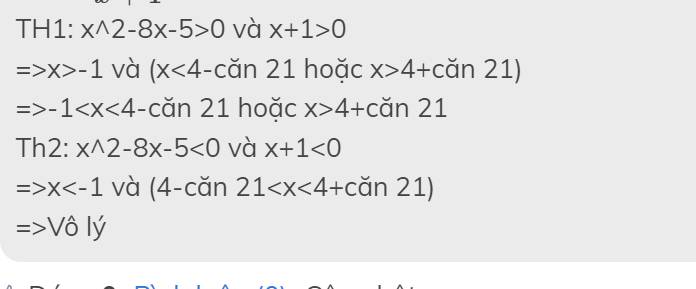
TH1: x^2-8x-5>0 và x+1>0
=>x>-1 và (x<4-căn 21 hoặc x>4+căn 21)
=>-1<x<4-căn 21 hoặc x>4+căn 21
Th2: x^2-8x-5<0 và x+1<0
=>x<-1 và (4-căn 21<x<4+căn 21)
=>Vô lý
a: \(E=\dfrac{x\left(x+1\right)}{\left(x-1\right)^2}:\left(\dfrac{x+1}{x}+\dfrac{1}{x-1}+\dfrac{2-x^2}{x\left(x-1\right)}\right)\)
\(=\dfrac{x\left(x+1\right)}{\left(x-1\right)^2}:\dfrac{x^2-1+x+2-x^2}{x\left(x-1\right)}\)
\(=\dfrac{x\left(x+1\right)}{\left(x-1\right)^2}\cdot\dfrac{x\left(x-1\right)}{x+1}=\dfrac{x^2}{x-1}\)
b: |x-3|=2
=>x-3=2 hoặc x-3=-2
=>x=5(nhận) hoặc x=1(loại)
Khi x=5 thì \(E=\dfrac{5^2}{5-1}=\dfrac{25}{4}\)
c: Để E=1/2 thì \(\dfrac{x^2}{x-1}=\dfrac{1}{2}\)
\(\Leftrightarrow2x^2-x+1=0\)
hay \(x\in\varnothing\)
f) \(A=\dfrac{x^2}{x-1}=\dfrac{x^2-x+x-1+1}{x-1}=\dfrac{x\left(x-1\right)+x-1+1}{x-1}=x+1+\dfrac{1}{x-1}=x-1+\dfrac{1}{x-1}+2\ge2\sqrt{\left(x-1\right).\dfrac{1}{x-1}}+2=4\)\(A=4\Leftrightarrow x=2\)
-Vậy \(A_{min}=4\)
Bài 1:
c) ĐKXĐ: \(x\notin\left\{\dfrac{1}{4};-\dfrac{1}{4}\right\}\)
Ta có: \(\dfrac{3}{1-4x}=\dfrac{2}{4x+1}-\dfrac{8+6x}{16x^2-1}\)
\(\Leftrightarrow\dfrac{-3\left(4x+1\right)}{\left(4x-1\right)\left(4x+1\right)}=\dfrac{2\left(4x-1\right)}{\left(4x+1\right)\left(4x-1\right)}-\dfrac{6x+8}{\left(4x-1\right)\left(4x+1\right)}\)
Suy ra: \(-12x-3=8x-2-6x-8\)
\(\Leftrightarrow-12x-3-2x+10=0\)
\(\Leftrightarrow-14x+7=0\)
\(\Leftrightarrow-14x=-7\)
\(\Leftrightarrow x=\dfrac{1}{2}\)(nhận)
Vậy: \(S=\left\{\dfrac{1}{2}\right\}\)
a: \(Y=\dfrac{3\left(x^2-x-1\right)-x^2+1}{\left(x+2\right)\left(x-1\right)}+\dfrac{x-2}{x}\cdot\dfrac{1-1+x}{1-x}\)
\(=\dfrac{2x^2-3x-2}{\left(x+2\right)\left(x-1\right)}+\dfrac{x-2}{x}\cdot\dfrac{-x}{x-1}\)
\(=\dfrac{2x^2-3x-2}{\left(x+2\right)\left(x-1\right)}-\dfrac{x-2}{x-1}\)
\(=\dfrac{2x^2-3x-2-x^2+4}{\left(x+2\right)\left(x-1\right)}=\dfrac{x^2-3x+2}{\left(x+2\right)\left(x-1\right)}=\dfrac{x-2}{x+2}\)
b: Y=2
=>2x+4=x-2
=>x=-6(nhận)
c; Y nguyên
=>x+2-4 chia hết cho x+2
=>x+2 thuộc {1;-1;2;-2;4;-4}
Kết hợp ĐKXĐ, ta được: x thuộc {-1;-3;-4;-6}
a.
\(y'=x^2+2\left(m^2-1\right)x+2m-3\)
\(y''=2x+2\left(m^2-1\right)\)
Hàm đạt cực đại tại \(x=2\) khi: \(\left\{{}\begin{matrix}y'\left(2\right)=0\\y''\left(2\right)< 0\end{matrix}\right.\)
\(\Rightarrow\left\{{}\begin{matrix}4+4\left(m^2-1\right)+2m-3=0\\4+2\left(m^2-1\right)< 0\end{matrix}\right.\)
Do \(2m^2+2>0\) ;\(\forall m\) nên ko tồn tại m thỏa mãn yêu cầu đề bài
b.
\(y'=x^2+2mx+3\)
\(y''=2x+2m\)
Hàm đạt cực đại tại \(x=-3\) khi: \(\left\{{}\begin{matrix}9-6m+3=0\\-6+2m< 0\end{matrix}\right.\) \(\Rightarrow\left\{{}\begin{matrix}m=2\\m< 3\end{matrix}\right.\)
\(\Rightarrow m=2\)
Bổ sung phần c và d luôn:
c, C = \(\dfrac{2}{5}\)
\(\Leftrightarrow\) \(\dfrac{x^2-1}{2x^2+3}\) = \(\dfrac{2}{5}\)
\(\Leftrightarrow\) 5(x2 - 1) = 2(2x2 + 3)
\(\Leftrightarrow\) 5x2 - 5 = 4x2 + 6
\(\Leftrightarrow\) x2 = 11
\(\Leftrightarrow\) x2 - 11 = 0
\(\Leftrightarrow\) (x - \(\sqrt{11}\))(x + \(\sqrt{11}\)) = 0
\(\Leftrightarrow\) \(\left[{}\begin{matrix}x-\sqrt{11}=0\\x+\sqrt{11}=0\end{matrix}\right.\)
\(\Leftrightarrow\) \(\left[{}\begin{matrix}x=\sqrt{11}\left(TM\right)\\x=-\sqrt{11}\left(TM\right)\end{matrix}\right.\)
d, Ta có: \(\dfrac{x^2-1}{2x^2+3}\) = \(\dfrac{x^2+\dfrac{3}{2}-\dfrac{5}{2}}{2\left(x^2+\dfrac{3}{2}\right)}\) = \(\dfrac{1}{2}\) - \(\dfrac{5}{4\left(x^2+\dfrac{3}{2}\right)}\)
C nguyên \(\Leftrightarrow\) \(\dfrac{5}{4\left(x^2+\dfrac{3}{2}\right)}\) nguyên \(\Leftrightarrow\) 5 \(⋮\) 4(x2 + \(\dfrac{3}{2}\))
\(\Leftrightarrow\) 4(x2 + \(\dfrac{3}{2}\)) \(\in\) Ư(5)
Xét các TH:
4(x2 + \(\dfrac{3}{2}\)) = 5 \(\Leftrightarrow\) x2 = \(\dfrac{-1}{4}\) \(\Leftrightarrow\) x2 + \(\dfrac{1}{4}\) = 0 (Vô nghiệm)
4(x2 + \(\dfrac{3}{2}\)) = -5 \(\Leftrightarrow\) x2 = \(\dfrac{-11}{4}\) \(\Leftrightarrow\) x2 + \(\dfrac{11}{4}\) = 0 (Vô nghiệm)
4(x2 + \(\dfrac{3}{2}\)) = 1 \(\Leftrightarrow\) x2 = \(\dfrac{-5}{4}\) \(\Leftrightarrow\) x2 + \(\dfrac{5}{4}\) = 0 (Vô nghiệm)
4(x2 + \(\dfrac{3}{2}\)) = -1 \(\Leftrightarrow\) x2 = \(\dfrac{-7}{4}\) \(\Leftrightarrow\) x2 + \(\dfrac{7}{4}\) = 0 (Vô nghiệm)
Vậy không có giá trị nào của x \(\in\) Z thỏa mãn C \(\in\) Z
Chúc bn học tốt! (Ko bt đề sai hay ko nữa :v)

Ta có: \(\frac{1-x}{2-x}=\frac{2}{3}\)\(\Rightarrow\)(1 - x).3= (2 - x).2
\(\Rightarrow\)3 - 3x = 4 - 2x
\(\Rightarrow\) 3 - 4 = - 2x + 3x
\(\Rightarrow\) -1 = 1x => x = -1
Vậy x= -1
\(\frac{1-x}{2-x}=\frac{2}{3}\)
\(\Rightarrow3.\left(1-x\right)=2.\left(2-x\right)\)
\(\Rightarrow3-3x=4-2x\)
\(\Rightarrow3-x=4\)
\(\Rightarrow x=-1\)