
Tìm giá trị lớn nhất, nhỏ nhất của hàm số:
y = \(\sqrt{x+2}+\sqrt{7-x}\)
Hãy nhập câu hỏi của bạn vào đây, nếu là tài khoản VIP, bạn sẽ được ưu tiên trả lời.

a: \(-1\le\sin x\le1\)
=>\(-1+1\le\sin x+1\le1+1\)
=>\(0\le\sin x+1\le2\)
=>\(0\le6\left(\sin x+1\right)\le2\cdot6=12\)
=>\(0\le\sqrt{6\left(\sin x+1\right)}\le\sqrt{12}=2\sqrt3\)
=>\(0-9\le\sqrt{6\left(\sin x+1\right)}-9\le=2\sqrt3-9\)
=>\(-9\le y\le2\sqrt3-9\)
Do đó, ta có:
\(y_{\min}=-9\) khi sin x=-1
=>\(x=-\frac{\pi}{2}+k2\pi\)
\(y_{\max}=2\sqrt3-9\) khi sin x=1
=>\(x=\frac{\pi}{2}+k2\pi\)
b: \(-1\le\sin\left(x+1\right)\le1\)
=>\(-4\le4\sin\left(x+1\right)\le4\)
=>\(-4-7\le4\sin\left(x+1\right)-7\le4-7\)
=>-11<=y<=-3
Vậy: \(y_{\min}=-11\) khi sin(x+1)=-1
=>\(x+1=-\frac{\pi}{2}+k2\pi\)
=>\(x=-\frac{\pi}{2}+k2\pi-1\)
\(y_{\max}\) =-3 khi sin(x+1)=1
=>\(x+1=\frac{\pi}{2}+k2\pi\)
=>\(x=\frac{\pi}{2}+k2\pi-1\)
ĐKXĐ : \(-1\le x\le3\)
- ADbu nhi : \(\left(\sqrt{x+1}+\sqrt{3-x}\right)^2\le\left(1^2+1^2\right)\left(\left(\sqrt{x+1}\right)^2+\left(\sqrt{3-x}\right)^2\right)\)
\(=2\left(x+1+3-x\right)=2.4=8\)
\(\Rightarrow\sqrt{x+1}+\sqrt{3-x}\le\sqrt{8}=2\sqrt{2}\)
- Dấu " = " xảy ra \(\Leftrightarrow\dfrac{1}{\sqrt{x+1}}=\dfrac{1}{\sqrt{3-x}}\)
\(\Leftrightarrow x+1=3-x\)
\(\Leftrightarrow x=1\left(TM\right)\)
\(\Rightarrow Max_{f\left(x\right)}=2\sqrt{2}\) tại x = 1.
- Có : \(\sqrt{x+1}+\sqrt{3-x}\ge\sqrt{x+1+3-x}=\sqrt{4}=2\)
- Dấu " = " xảy ra <=> x = -1 ( TM )
\(\Rightarrow Min_{f\left(x\right)}=2\) tại x = - 1 .
ĐKXĐ: \(1954\le x\le2014\)
y = \(\sqrt{x-1954}+\sqrt{2014-x}\ge\sqrt{x-1954+2014-x}=\sqrt{60}=2\sqrt{15}\)
ĐTXR <=> (x-1954)(2014-x) = 0 <=>\(\orbr{\begin{cases}x=1954\\x=2014\end{cases}}\)
Vậy GTNN y = \(2\sqrt{15}\)khi x = 1954 hoặc x = 2014
y = \(\sqrt{x-1954}+\sqrt{2014-x}\le\sqrt{2\left(x-1954+2014-x\right)}=\sqrt{2\cdot60}=\sqrt{120}=2\sqrt{30}\)
ĐTXR <=> x - 1954 = 2014 - x <=> x = 1984 (thỏa ĐKXĐ)
Vậy GTLN y = \(2\sqrt{30}\)khi x=1984
Bài này áp dụng bất đẳng thức phụ: \(\sqrt{a}+\sqrt{b}\ge\sqrt{a+b}\) (Dau "=" xay ra khi ab=0)
va bat dang thuc \(\sqrt{a}+\sqrt{b}\le\sqrt{2\left(a+b\right)}\) (Dau "=" xay ra khi a=b)
Ở dưới chưa chứng minh bất đẳng thức nên chứng minh thêm nha, không được ghi thẳng như ở dưới
Lời giải:
a. $y=\sqrt{x^2+x-2}\geq 0$ (tính chất cbh số học)
Vậy $y_{\min}=0$. Giá trị này đạt tại $x^2+x-2=0\Leftrightarrow x=1$ hoặc $x=-2$
b.
$y^2=6+2\sqrt{(2+x)(4-x)}\geq 6$ do $2\sqrt{(2+x)(4-x)}\geq 0$ theo tính chất căn bậc hai số học
$\Rightarrow y\geq \sqrt{6}$ (do $y$ không âm)
Vậy $y_{\min}=\sqrt{6}$ khi $x=-2$ hoặc $x=4$
$y^2=(\sqrt{2+x}+\sqrt{4-x})^2\leq (2+x+4-x)(1+1)=12$ theo BĐT Bunhiacopxky
$\Rightarrow y\leq \sqrt{12}=2\sqrt{3}$
Vậy $y_{\max}=2\sqrt{3}$ khi $2+x=4-x\Leftrightarrow x=1$
c. ĐKXĐ: $-2\leq x\leq 2$
$y^2=(x+\sqrt{4-x^2})^2\leq (x^2+4-x^2)(1+1)$ theo BĐT Bunhiacopxky
$\Leftrightarrow y^2\leq 8$
$\Leftrightarrow y\leq 2\sqrt{2}$
Vậy $y_{\max}=2\sqrt{2}$ khi $x=\sqrt{2}$
Mặt khác:
$x\geq -2$
$\sqrt{4-x^2}\geq 0$
$\Rightarrow y\geq -2$
Vậy $y_{\min}=-2$ khi $x=-2$
Mấy cái bước suy ra ≥;≤ là có công thức hay là định lý gì không ạ ?
a: \(-1\le\sin x\le1\)
=>\(-1+1\le\sin x+1\le1+1\)
=>\(0\le\sin x+1\le2\)
=>\(0\le3\left(\sin x+1\right)\le6\)
=>\(0\le\sqrt{3\left(\sin x+1\right)}\le\sqrt6\)
=>\(0-5\le\sqrt{3\left(\sin x+1\right)}-5\le\sqrt6-5\)
=>-5<=y<=\(\sqrt6-5\)
Do đó: \(y_{\min}=-5\) khi sin x=-1
=>\(x=-\frac{\pi}{2}+k2\pi\)
\(y_{\max}=\sqrt6-5\) khi sin x=1
=>\(x=\frac{\pi}{2}+k2\pi\)
b: \(-1\le\sin\left(x+8\right)\le1\)
=>\(-6\le6\sin\left(x+8\right)\le6\)
=>\(-6-5\le6\sin\left(x+8\right)-5\le6-5\)
=>-11<=y<=1
Vậy: \(y_{\min}=-11\) khi sin (x+8)=-1
=>\(x+8=-\frac{\pi}{2}+k2\pi\)
=>\(x=-\frac{\pi}{2}+k2\pi-8\)
\(y_{\max}=1\) khi sin(x+8)=1
=>\(x+8=\frac{\pi}{2}+k2\pi\)
=>\(x=\frac{\pi}{2}+k2\pi-8\)
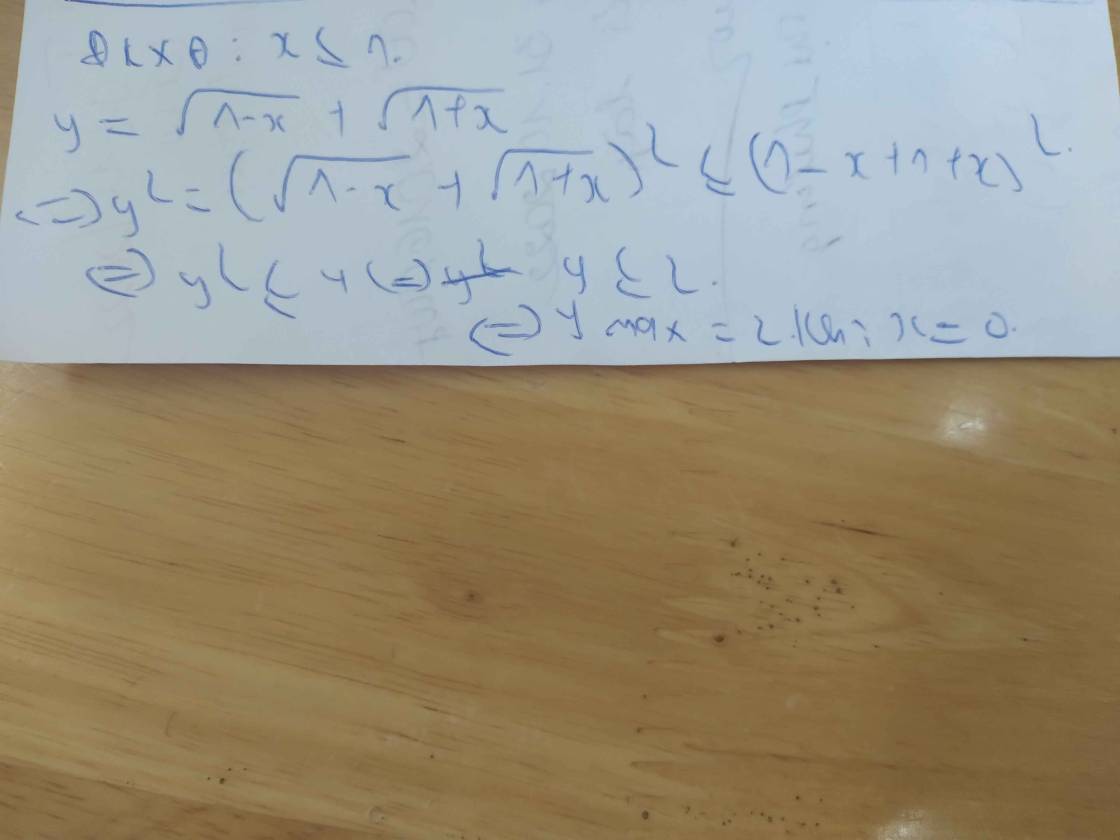
ĐKXĐ : \(-2\le x\le7\)
- Áp dụng BĐT bunhiacopxky có :
\(y^2=\left(\sqrt{x+2}+\sqrt{7-x}\right)^2\le\left(1^2+1^2\right)\left(x+2+7-x\right)=18\)
\(\Leftrightarrow y\le3\sqrt{2}\)
- Dấu " = " xảy ra <=> \(\sqrt{x+2}=\sqrt{7-x}\)\(\Leftrightarrow x=\dfrac{5}{2}\)
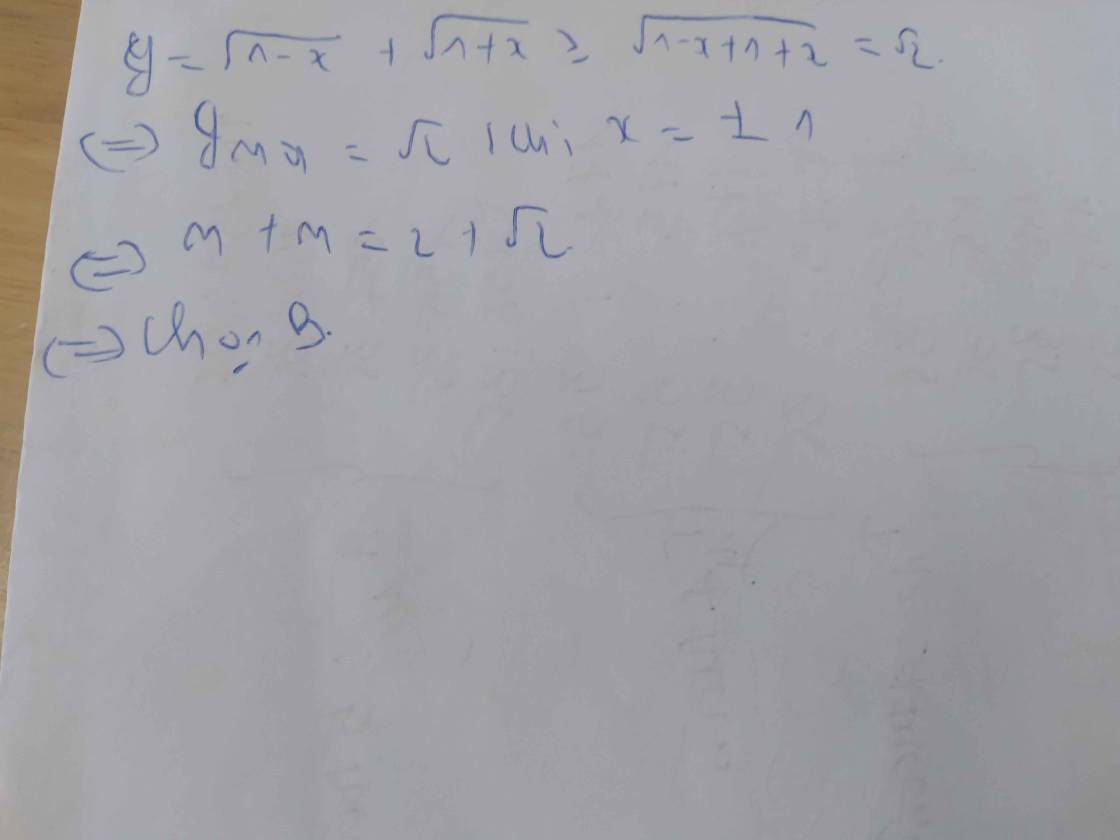
-Lại có : \(y=\sqrt{x+2}+\sqrt{7-x}\ge\sqrt{x+2+7-x}=3\)
- Dấu " = " xảy ra <=> \(\sqrt{\left(x+2\right)\left(x-7\right)}=0\) \(\Leftrightarrow\left[{}\begin{matrix}x=-2\\x=7\end{matrix}\right.\)
Vậy ...