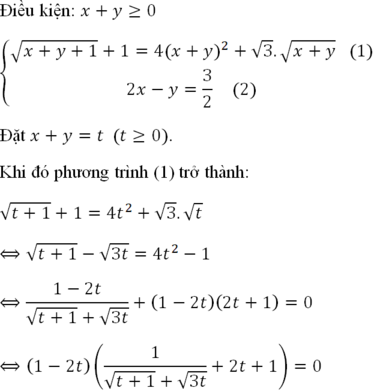
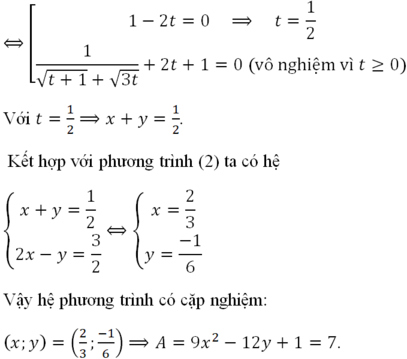
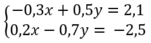
Hệ phương trình có nghiệm là
Hãy nhập câu hỏi của bạn vào đây, nếu là tài khoản VIP, bạn sẽ được ưu tiên trả lời.
\(a,\text{Thay }x=-2;y=3\\ HPT\Leftrightarrow\left\{{}\begin{matrix}3m-2=4\\3-2n=-3\end{matrix}\right.\Leftrightarrow\left\{{}\begin{matrix}m=2\\n=3\end{matrix}\right.\\ b,HPT\Leftrightarrow\left\{{}\begin{matrix}x=4-my\\n\left(4-my\right)+y=-3\end{matrix}\right.\Leftrightarrow\left\{{}\begin{matrix}x=4-my\\4n-mny+y=-3\end{matrix}\right.\\ \Leftrightarrow\left\{{}\begin{matrix}x=4-my\\y\left(mn-1\right)=4n+3\end{matrix}\right.\)
HPT có vô số nghiệm \(\Leftrightarrow\left\{{}\begin{matrix}mn-1=0\\4n+3=0\end{matrix}\right.\Leftrightarrow\left\{{}\begin{matrix}m=-\dfrac{4}{3}\\n=-\dfrac{3}{4}\end{matrix}\right.\)
Đặt \(x+\dfrac{1}{x}=a;y+\dfrac{1}{y}=b\left(\left|a\right|\ge2;\left|b\right|\ge2\right)\)
\(\left\{{}\begin{matrix}x+\dfrac{1}{x}+y+\dfrac{1}{y}=5\\x^3+y^3+\dfrac{1}{x^3}+\dfrac{1}{y^3}=15m-25\end{matrix}\right.\)
\(\Leftrightarrow\left\{{}\begin{matrix}x+\dfrac{1}{x}+y+\dfrac{1}{y}=5\\\left(x^3+\dfrac{1}{x^3}\right)+\left(y^3+\dfrac{1}{y^3}\right)=15m-25\end{matrix}\right.\)
\(\Leftrightarrow\left\{{}\begin{matrix}x+\dfrac{1}{x}+y+\dfrac{1}{y}=5\\\left(x+\dfrac{1}{x}\right)^3-3\left(x+\dfrac{1}{x}\right)+\left(y+\dfrac{1}{y}\right)^3-3\left(y+\dfrac{1}{y}\right)=15m-25\end{matrix}\right.\)
\(\Leftrightarrow\left\{{}\begin{matrix}x+\dfrac{1}{x}+y+\dfrac{1}{y}=5\\\left(x+\dfrac{1}{x}\right)^3+\left(y+\dfrac{1}{y}\right)^3-3\left(x+\dfrac{1}{x}+y+\dfrac{1}{y}\right)=15m-25\end{matrix}\right.\)
\(\Leftrightarrow\left\{{}\begin{matrix}x+\dfrac{1}{x}+y+\dfrac{1}{y}=5\\\left(x+\dfrac{1}{x}\right)^3+\left(y+\dfrac{1}{y}\right)^3=15m-10\end{matrix}\right.\)
\(\Leftrightarrow\left\{{}\begin{matrix}a+b=5\\a^3+b^3=15m-10\end{matrix}\right.\)
\(\Leftrightarrow\left\{{}\begin{matrix}a+b=5\\\left(a+b\right)^3-3ab\left(a+b\right)=15m-10\end{matrix}\right.\)
\(\Leftrightarrow\left\{{}\begin{matrix}a+b=5\\125-15ab=15m-10\end{matrix}\right.\)
\(\Leftrightarrow\left\{{}\begin{matrix}a+b=5\\ab=9-m\end{matrix}\right.\)
\(\Rightarrow a,b\) là nghiệm của phương trình \(t^2-5t+9-m=0\left(1\right)\)
a, Nếu \(m=3\), phương trình \(\left(1\right)\) trở thành
\(t^2-5t+6=0\)
\(\Leftrightarrow\left[{}\begin{matrix}t=2\\t=3\end{matrix}\right.\)
\(\Leftrightarrow\left[{}\begin{matrix}\left\{{}\begin{matrix}a=2\\b=3\end{matrix}\right.\\\left\{{}\begin{matrix}a=3\\b=2\end{matrix}\right.\end{matrix}\right.\)
TH1: \(\left\{{}\begin{matrix}x+\dfrac{1}{x}=2\\y+\dfrac{1}{y}=3\end{matrix}\right.\Leftrightarrow\left\{{}\begin{matrix}\left(x-1\right)^2=0\\y^2-3y+1=0\end{matrix}\right.\Leftrightarrow\left\{{}\begin{matrix}x=1\\y=\dfrac{3\pm\sqrt{5}}{2}\end{matrix}\right.\)
TH2: \(\left\{{}\begin{matrix}x+\dfrac{1}{x}=3\\y+\dfrac{1}{y}=2\end{matrix}\right.\Leftrightarrow\left\{{}\begin{matrix}x=\dfrac{3\pm\sqrt{5}}{2}\\y=1\end{matrix}\right.\)
Vậy ...
b, \(\left(1\right)\Leftrightarrow t=\dfrac{5\pm\sqrt{4m-11}}{2}\left(m\ge\dfrac{11}{4}\right)\)
\(\left(1\right)\Leftrightarrow\left\{{}\begin{matrix}a=\dfrac{5\pm\sqrt{4m-11}}{2}\\b=\dfrac{5\mp\sqrt{4m-11}}{2}\end{matrix}\right.\)
\(\Leftrightarrow\left\{{}\begin{matrix}x+\dfrac{1}{x}=\dfrac{5\pm\sqrt{4m-11}}{2}\\y+\dfrac{1}{y}=\dfrac{5\mp\sqrt{4m-11}}{2}\end{matrix}\right.\)
\(\Leftrightarrow\left\{{}\begin{matrix}2x^2-\left(5\pm\sqrt{4m-11}\right)+2=0\left(2\right)\\2y^2-\left(5\mp\sqrt{4m-11}\right)+2=0\end{matrix}\right.\)
Yêu cầu bài toán thỏa mãn khi phương trình \(\left(2\right)\) có nghiệm dương
\(\Leftrightarrow\left\{{}\begin{matrix}\Delta=\left(5\pm\sqrt{4m-11}\right)^2-16\ge0\\\dfrac{5\pm\sqrt{4m-11}}{2}>0\\1>0\end{matrix}\right.\)
\(\Leftrightarrow...\)
a Để hpt có nghiệm \(\left(x;y\right)=\left(-2;3\right)\) \(\Rightarrow\left\{{}\begin{matrix}-2+3m=4\\-2n+3=-3\end{matrix}\right.\) \(\Leftrightarrow\left\{{}\begin{matrix}3m=6\\-2n=-6\end{matrix}\right.\Leftrightarrow\left\{{}\begin{matrix}m=2\\n=2\end{matrix}\right.\)
b Để hpt có vô số nghiệm \(\Leftrightarrow\dfrac{1}{n}=\dfrac{m}{1}=\dfrac{4}{-3}\) \(\left(\dfrac{a}{a'}=\dfrac{b}{b'}=\dfrac{c}{c'}\right)\)
\(\Leftrightarrow\left\{{}\begin{matrix}\dfrac{1}{n}=-\dfrac{4}{3}\\m=-\dfrac{4}{3}\end{matrix}\right.\) \(\Leftrightarrow\left\{{}\begin{matrix}m=-\dfrac{4}{3}\\n=-\dfrac{3}{4}\end{matrix}\right.\)
Vậy...
a: Vì \(\dfrac{1}{2}\ne-\dfrac{2}{1}\)
nên hệ luôn có nghiệm duy nhất
\(\left\{{}\begin{matrix}x-2y=3-m\\2x+y=3\left(m+2\right)\end{matrix}\right.\)
=>\(\left\{{}\begin{matrix}x-2y=3-m\\4x+2y=6\left(m+2\right)=6m+12\end{matrix}\right.\)
=>\(\left\{{}\begin{matrix}5x=3-m+6m+12=5m+15\\x-2y=3-m\end{matrix}\right.\)
=>\(\left\{{}\begin{matrix}x=m+3\\2y=x-3+m=m+3-3+m=2m\end{matrix}\right.\)
=>\(\left\{{}\begin{matrix}x=m+3\\y=m\end{matrix}\right.\)
Để x>0 và y<0 thì \(\left\{{}\begin{matrix}m+3>0\\m< 0\end{matrix}\right.\)
=>-3<m<0
b: \(A=x^2+y^2=\left(m+3\right)^2+m^2\)
\(=2m^2+6m+9\)
\(=2\left(m^2+3m+\dfrac{9}{2}\right)\)
\(=2\left(m^2+3m+\dfrac{9}{4}+\dfrac{9}{4}\right)\)
\(=2\left(m+\dfrac{3}{2}\right)^2+\dfrac{9}{2}>=\dfrac{9}{2}\forall m\)
Dấu '=' xảy ra khi \(m+\dfrac{3}{2}=0\)
=>\(m=-\dfrac{3}{2}\)
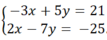
Chú ý. Đối với những hệ phương trình có hệ số thập phân như thế này ta nên nhân với 10 để có hệ phương trình hệ số nguyên:
![]()
Thay vào ta thấy phương án A sai, còn phương án B đúng. Vậy đáp án là B.
Đáp án: B
Để hệ có nghiệm duy nhất thì \(\frac{a+1}{a}<>\frac{-1}{1}=-1\)
=>a+1<>-a
=>2a+1<>0
=>a<>-1/2
\(\begin{cases}\left(a+1\right)x-y=3\\ ax+y=a\end{cases}\Rightarrow\begin{cases}x\cdot\left(a+1\right)-y+x\cdot a+y=3+a\\ ax+y=a\end{cases}\)
=>\(\begin{cases}x\left(2a+1\right)=a+3\\ y=a-a\cdot x\end{cases}\Rightarrow\begin{cases}x=\frac{a+3}{2a+1}\\ y=a-a\cdot\frac{a+3}{2a+1}=\frac{2a^2+a-a^2-3a}{2a+1}=\frac{a^2-2a}{2a+1}\end{cases}\)
x+y>0
=>\(\frac{a^2-2a}{2a+1}+\frac{a+3}{2a+1}>0\)
=>\(\frac{a^2-a+3}{2a+1}>0\)
mà \(a^2-a+3=\left(a-\frac12\right)^2+\frac{11}{4}>0\forall a\)
nên 2a+1>0
=>2a>-1
=>\(a>-\frac12\)
Bài 2:
Để hệ có nghiệm duy nhất thì \(\frac{m}{1}<>\frac{1}{m}\)
=>\(m^2<>1\)
=>m∉{1;-1}
\(\begin{cases}mx+y=m^2\\ x+my=1\end{cases}\Rightarrow\begin{cases}mx+y=m^2\\ mx+m^2y=m\end{cases}\)
=>\(\begin{cases}mx+m^2y-mx-y=m-m^2\\ x+my=1\end{cases}\Rightarrow\begin{cases}y\left(m^2-1\right)=-m\left(m-1\right)\\ x+my=1\end{cases}\)
=>\(\begin{cases}y=\frac{-m\left(m-1\right)}{\left(m-1\right)\left(m+1\right)}=\frac{-m}{m+1}\\ x=1-my=1-\frac{m\left(-m\right)}{m+1}=\frac{m+1+m^2}{m+1}\end{cases}\)
x+y>0
=>\(\frac{m^2+m+1-m}{m+1}>0\)
=>\(\frac{m^2+1}{m+1}>0\)
=>m+1>0
=>m>-1
=>m>-1 và m<>1
Bài 1:
Để hệ có nghiệm duy nhất thì \(\frac{m}{9}<>\frac{1}{m}\)
=>\(m^2<>9\)
=>m∉{3;-3}
\(\begin{cases}mx+y=3\\ 9x+my=2m+3\end{cases}\Rightarrow\begin{cases}y=3-mx\\ 9x+m\left(3-mx\right)=2m+3\end{cases}\)
=>\(\begin{cases}y=3-mx\\ 9x+3m-m^2x=2m+3\end{cases}\Rightarrow\begin{cases}y=3-mx\\ x\left(9-m^2\right)=3-m\end{cases}\)
=>\(\begin{cases}x=\frac{3-m}{9-m^2}=\frac{\left(3-m\right)}{\left(3-m\right)\left(3+m\right)}=\frac{1}{m+3}\\ y=3-mx=3-\frac{m}{m+3}=\frac{3m+9-m}{m+3}=\frac{2m+9}{m+3}\end{cases}\)
3x+2y=9
=>\(\frac{3}{m+3}+\frac{2\left(2m+9\right)}{m+3}=9\)
=>9(m+3)=3+2(2m+9)=3+4m+18=4m+21
=>9m+27=4m+21
=>5m=-6
=>m=-6/5(nhận)
Để hệ phương trình có nghiệm duy nhất thì \(\dfrac{m}{3}\ne-\dfrac{1}{m}\)
=>\(m^2\ne-3\)(luôn đúng)
\(\left\{{}\begin{matrix}mx-y=2\\3x+my=5\end{matrix}\right.\)
=>\(\left\{{}\begin{matrix}y=mx-2\\3x+m\cdot\left(mx-2\right)=5\end{matrix}\right.\Leftrightarrow\left\{{}\begin{matrix}y=mx-2\\x\left(m^2+3\right)=5+2m\end{matrix}\right.\)
=>\(\left\{{}\begin{matrix}y=mx-2\\x=\dfrac{2m+5}{m^2+3}\end{matrix}\right.\Leftrightarrow\left\{{}\begin{matrix}x=\dfrac{2m+5}{m^2+3}\\y=\dfrac{2m^2+5m}{m^2+3}-2=\dfrac{2m^2+5m-2m^2-6}{m^2+3}\end{matrix}\right.\)
=>\(\left\{{}\begin{matrix}x=\dfrac{2m+5}{m^2+3}\\y=\dfrac{5m-6}{m^2+3}\end{matrix}\right.\)
\(x+y=\dfrac{3}{m^2+3}\)
=>\(\dfrac{2m+5+5m-6}{m^2+3}=\dfrac{3}{m^2+3}\)
=>\(7m-1=3\)
=>7m=4
=>m=4/7(nhận)


Đáp án là D
Vậy hệ phương trình có nghiệm (x; y) = ( 3 ; - 3 )