
Hãy nhập câu hỏi của bạn vào đây, nếu là tài khoản VIP, bạn sẽ được ưu tiên trả lời.
 (x4 – x2 + x - 1) =
 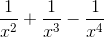 ) = +∞.
 (-2x3 + 3x2 -5 ) =
  ) = +∞.
 =
= 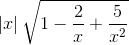 = +∞.
= +∞. =
= 
 =
=  = -1.
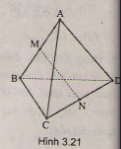
= -1. Cho tam giác ABC. Lấy điểm S nằm ngoài mặt phẳng (ABC). Trên đoạn SA lấy điểm M sao cho
#Hỏi cộng đồng OLM
#Toán lớp 11

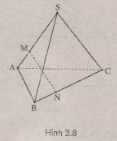
=
+
+
= +
+
(1)
=
+
+
= +
+
(2)
Nhân (2) với 2 rồi cộng với (1) ta được: =
+
Vậy ,
,
đồng phẳng.
tìm giá trị nhỏ nhất và giá trị lớn nhất của các hàm số sau:
a/ y =
#Hỏi cộng đồng OLM
#Toán lớp 11
a) Hàm số f(x) = xác định trên R\{
} và ta có x = 4 ∈ (
;+∞).
Giả sử (xn) là dãy số bất kì và xn ∈ (;+∞); xn ≠ 4 và xn → 4 khi n → +∞.
Ta có lim f(xn) = lim =
=
.
Vậy
=
.
b) Hàm số f(x) = xác định trên R.
Giả sử (xn) là dãy số bất kì và xn → +∞ khi n → +∞.
Ta có lim f(xn) = lim = lim
= -5.
Vậy
= -5.
Một thấu kính hội tụ có tiêu cự là f. Gọi d và d' lần lượt là khoảng cách từ một vật thật AB và từ ảnh A'B' của nó tới quang tâm O của thấu kính (h.54). Công thức thấu kính là 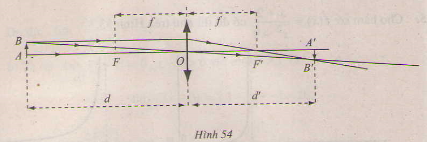
a) Tìm biểu thức xác định hàm số d' = φ(d).
b) Tìm
#Hỏi cộng đồng OLM
#Toán lớp 11
a) Từ hệ thức suy ra d' = φ(d) =
.
b) +) φ(d) =
= +∞ .
Ý nghĩa: Nếu vật thật AB tiến dần về tiêu điểm F sao cho d luôn lớn hơn f thì ảnh của nó dần tới dương vô cực.
+) φ(d) =
= -∞.
Ý nghĩa: Nếu vật thật AB tiến dần về tiêu điểm F sao cho d luôn nhỏ hơn f thì ảnh của nó dần tới âm vô sực.
+) φ(d) =
=
= f.
Ý nghĩa: Nếu vật thật AB ở xa vô cực so với thấu kính thì ảnh của nó ở ngay trên tiêu diện ảnh (mặt phẳng qua tiêu điểm ảnh F' và vuông góc với trục chính).
Bài 1. Trong các dãy số sau đây, dãy số nào là cấp số cộng? Tính số hạng đầu và công sai của nó:
a) un = 5 - 2n; b) un =
#Hỏi cộng đồng OLM
#Toán lớp 11
+) Hàm số f(x) = xác định khi và chỉ khi x2+ x - 6 ≠ 0 <=> x ≠ -3 và x ≠ 2.
Hàm số f(x) liên tục trên các khoảng (-∞; -3), (-3; 2) và (2; +∞)
+) Hàm số g(x) = tanx + sinx xác định khi và chỉ khi
tanx ≠ 0 <=> x ≠ +kπ với k ∈ Z.
Hàm số g(x) liên tục trên các khoảng ( - +kπ;
+kπ) với k ∈ Z.
In today's digital era, the disparity between the youth’s knowledge of international celebrities and local historical figures is increasingly evident. This phenomenon stems from the pervasive influence of global media and a perceived disconnect between history and contemporary life. The primary reason for this trend is the ubiquity of social media and global entertainment platforms. International pop stars and movie icons are constantly showcased, providing high-quality, engaging, and highly relatable content that captures the attention of young people instantly. Conversely, national history is frequently portrayed through dry, static textbooks, which can make historical figures seem distant, two-dimensional, and irrelevant to the modern world. While pop culture is perceived as dynamic and part of the "now," history is often unfairly categorized as something stagnant. To bridge this gap, historical education must evolve. Rather than relying solely on traditional rote learning, curricula should incorporate modern multimedia resources, such as short-form documentaries, historical films, and interactive digital tours of cultural monuments. Furthermore, educators could highlight the human side of historical figures—their personal struggles, dilemmas, and triumphs—to make them more relatable, mirroring the emotional connection fans feel toward modern icons. Integrating history into popular media through gamification and engaging social media campaigns can transform the study of the past from a chore into a compelling cultural experience. Ultimately, by modernizing how history is presented and emphasizing its ongoing relevance to modern identity, society can cultivate a stronger appreciation for national heritage among the youth. Balancing global curiosity with a grounded understanding of one’s own origins is essential for developing a well-rounded perspective.