Hãy nhập câu hỏi của bạn vào đây, nếu là tài khoản VIP, bạn sẽ được ưu tiên trả lời.

\(a.\left(x-3\right)\left(x+4\right)-2\left(3x-2\right)=\left(x-4\right)^2\\\Leftrightarrow x^2+4x-3x-12-6x+4=x^2-8x+16\\\Leftrightarrow x^2-x^2+4x-3x-6x+8x=+12-4+16=0\\\Leftrightarrow 3x=24\\\Leftrightarrow x=8\)
Vậy \(x=8\) để \(A=B\)
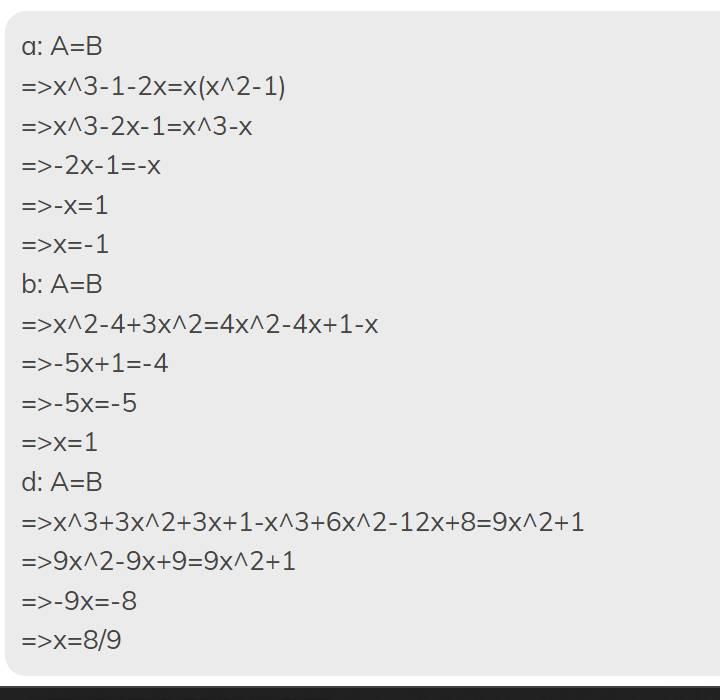
a) A= (x-3)(x+4)-2(3x-2) và B= (x-4)²
ta có:
(x−3)(x+4)−2(3x−2)= (x-4)²
=> \(x^2-5x-8=x^2-8x+16\)
=>3x=24
=>x=8
b) A= (x+2)(x-2)+3x² và B= (2x+1)² +2x
Ta có:
\(\left(x+2\right)\left(x-2\right)+3x^2=\left(2x+1\right)^2+2x\)
=> \(4x^2-4=4x^2+6x+1\)
=>6x=−5
=>\(x=-\frac{5}{6}\)
c) A= (x-1)(x²+x+1)-2x và B= x(x-1)(x+1)
ta có:
\(\left(x-1\right)\left(x^2+x+1\right)-2x=x\left(x+1\right)\left(x+1\right)\)
=>\(x^3-1-2x=x\left(x^2-1\right)\)
=>\(x^3-1-2x=x^3-x\)
=>\(x=-1\)
d) A= (x+1)³ -(x-2)³ và B= (3x-1)(3x+1)
ta có:
\(\left(x+1\right)^3-\left(x-2\right)^3=\left(3x-1\right)\left(3x+1\right)\)
=>\(9x^2+9x+9=9x^2-1\)
=>\(9x=10\)
=>x=\(\frac{10}{9}\)
chúc bạn học tốt
#Nghi
Câu 1:
a: \(2x^2\left(x^2+3x+\frac12\right)\)
\(=2x^2\cdot x^2+2x^2\cdot3x+2x^2\cdot\frac12\)
\(=2x^4+6x^3+x^2\)
b: \(\left(x+1\right)\left(x-2\right)-\left(x+2\right)^2\)
\(=x^2-2x+x-2-\left(x^2+4x+4\right)\)
\(=x^2-x-2-x^2-4x-4=-5x-6\)
c: \(\left(3x+1\right)^2-9x\left(x+3\right)\)
\(=9x^2+6x+1-9x^2-27x\)
=-21x+1
Câu 2:
a: \(\left(x+2\right)^2-x\left(x+4\right)+10\)
\(=x^2+4x+4-x^2-4x+10\)
=4+10
=14
=>Biểu thức này không phụ thuộc vào biến
b: \(\left(x+3\right)\left(4x-1\right)-\left(2x+1\right)^2-7x+3\)
\(=4x^2-x+12x-3-4x^2-4x-1-7x+3\)
=12x-x-7x-4x-3-1+3
=x(12-1-7-4)-1
=-1
=>Biểu thức này không phụ thuộc vào biến
Câu 3:
a: \(\left(x+2\right)^2-x\left(x-1\right)=2\)
=>\(x^2+4x+4-x^2+x=2\)
=>5x+4=2
=>5x=2-4=-2
=>\(x=-\frac25\)
b: \(\left(2x+1\right)^2-\left(x+1\right)\left(4x-3\right)=-3\)
=>\(4x^2+4x+1-\left(4x^2-3x+4x-3\right)=-3\)
=>\(4x^2+4x+1-\left(4x^2+x-3\right)=-3\)
=>\(4x^2+4x+1-4x^2-x+3=-3\)
=>3x+4=-3
=>3x=-7
=>\(x=-\frac73\)
Câu 5
Xét ΔADC và ΔBCD có
AD=BC
DC chung
AC=BD
Do đó: ΔADC=ΔBCD
=>\(\hat{ACD}=\hat{BDC}\)
=>\(\hat{OCD}=\hat{ODC}\)
=>ΔOCD cân tại O
=>OC=OD
Ta có: OC+OA=AC
OD+OB=BD
mà OC=OD và AC=BD
nên OA=OB
a: Để \(\dfrac{3x-2}{4}\) không nhỏ hơn \(\dfrac{3x+3}{6}\) thì \(\dfrac{3x-2}{4}>=\dfrac{3x+3}{6}\)
=>\(\dfrac{6\left(3x-2\right)}{24}>=\dfrac{4\left(3x+3\right)}{24}\)
=>18x-12>=12x+12
=>6x>=24
=>x>=4
b: Để \(\left(x+1\right)^2\) nhỏ hơn \(\left(x-1\right)^2\) thì \(\left(x+1\right)^2< \left(x-1\right)^2\)
=>\(x^2+2x+1< x^2-2x+1\)
=>4x<0
=>x<0
c: Để \(\dfrac{2x-3}{35}+\dfrac{x\left(x-2\right)}{7}\) không lớn hơn \(\dfrac{x^2}{7}-\dfrac{2x-3}{5}\) thì
\(\dfrac{2x-3}{35}+\dfrac{x\left(x-2\right)}{7}< =\dfrac{x^2}{7}-\dfrac{2x-3}{5}\)
=>\(\dfrac{2x-3+5x\left(x-2\right)}{35}< =\dfrac{5x^2-7\cdot\left(2x-3\right)}{35}\)
=>\(2x-3+5x^2-10x< =5x^2-14x+21\)
=>-8x-3<=-14x+21
=>6x<=24
=>x<=4