
DN
6

Hãy nhập câu hỏi của bạn vào đây, nếu là tài khoản VIP, bạn sẽ được ưu tiên trả lời.
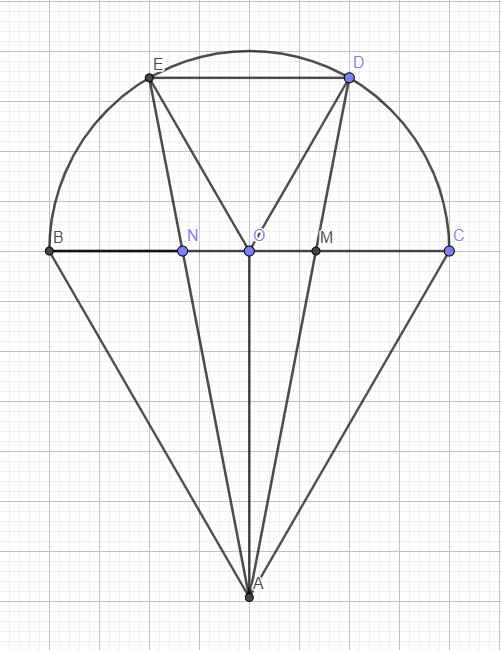
Gọi O là tâm đường tròn \(\Rightarrow\) O là trung điểm BC
\(\stackrel\frown{BE}=\stackrel\frown{ED}=\stackrel\frown{DC}\Rightarrow\widehat{BOE}=\widehat{EOD}=\widehat{DOC}=\dfrac{180^0}{3}=60^0\)
Mà \(OD=OE=R\Rightarrow\Delta ODE\) đều
\(\Rightarrow ED=R\)
\(BN=NM=MC=\dfrac{2R}{3}\Rightarrow\dfrac{NM}{ED}=\dfrac{2}{3}\)
\(\stackrel\frown{BE}=\stackrel\frown{DC}\Rightarrow ED||BC\)
Áp dụng định lý talet:
\(\dfrac{AN}{AE}=\dfrac{MN}{ED}=\dfrac{2}{3}\Rightarrow\dfrac{EN}{AN}=\dfrac{1}{2}\)
\(\dfrac{ON}{BN}=\dfrac{OB-BN}{BN}=\dfrac{R-\dfrac{2R}{3}}{\dfrac{2R}{3}}=\dfrac{1}{2}\)
\(\Rightarrow\dfrac{EN}{AN}=\dfrac{ON}{BN}=\dfrac{1}{2}\) và \(\widehat{ENO}=\widehat{ANB}\) (đối đỉnh)
\(\Rightarrow\Delta ENO\sim ANB\left(c.g.c\right)\)
\(\Rightarrow\widehat{NBA}=\widehat{NOE}=60^0\)
Hoàn toàn tương tự, ta có \(\Delta MDO\sim\Delta MAC\Rightarrow\widehat{MCA}=\widehat{MOD}=60^0\)
\(\Rightarrow\Delta ABC\) đều
bài 3
a)\(\Delta=9->\sqrt{\Delta}=3\)
\(x_1=\dfrac{5+3}{2.2}=2;x_2=\dfrac{5-3}{2.2}=\dfrac{1}{2}\)
b) Áp dụng hệ thức Vi-ét
\(\dfrac{m+3}{2}=\dfrac{5m}{4}->m=2\)
c) \(\left(x_1-x_2\right)^2=\left(x_1+x_2\right)^2-4x_1.x_2=\dfrac{\left(m+3\right)^2}{4}-4.\dfrac{m}{2}=\dfrac{\left(m-1\right)^2+8}{4}\ge2\Leftrightarrow\left|x_1-x_2\right|\ge\sqrt{2}\)
Vậy MinP=\(\sqrt{2}\) <=> x=1.
Mình làm hơi tắt,có gì ko hiểu cứ bình luận phía dưới :)
c)\(\sqrt{4-\sqrt{7}}-\sqrt{4+\sqrt{7}}\)
=\(\dfrac{\sqrt{8-2\sqrt{7}}}{\sqrt{2}}-\dfrac{\sqrt{8+2\sqrt{7}}}{\sqrt{2}}\)
=\(\dfrac{\sqrt{\left(\sqrt{7}-1\right)^2}}{\sqrt{2}}-\dfrac{\sqrt{\left(\sqrt{7}+1\right)^2}}{\sqrt{2}}\)
=\(\dfrac{\left|\sqrt{7}-1\right|-\left|\sqrt{7}+1\right|}{\sqrt{2}}\)
=\(\dfrac{\sqrt{7}-1-\sqrt{7}-1}{\sqrt{2}}\)
=\(\dfrac{-2}{\sqrt{2}}\)
=\(-\sqrt{2}\)
Bài 4:
a)
\(M=x+\sqrt{2-x}=-\left(2-x\right)+\sqrt{2-x}+2\)
Đặt \(\sqrt{2-x}=m\left(m\ge0\right)\)
\(\Rightarrow M=-m^2+m+2\)
\(=-\left(m^2-m+\dfrac{1}{4}\right)+\dfrac{1}{4}+2\)
\(=\dfrac{9}{4}-\left(m-\dfrac{1}{2}\right)^2\le\dfrac{9}{4}\)
Dấu "=" xảy ra khi \(m=\dfrac{1}{2}\Leftrightarrow\sqrt{2-x}=\dfrac{1}{2}\Leftrightarrow x=\dfrac{7}{4}\)
b)
\(5x^2+9y^2-12xy+8=24\left(2y-x-3\right)\)
\(\Leftrightarrow5x^2+24x+9y^2-48y-12xy+80=0\)
\(\Leftrightarrow\left(4x^2+9y^2+64-12xy-48y+32x\right)+\left(x^2-8x+16\right)=0\)
\(\Leftrightarrow\left(2x-3y+8\right)^2+\left(x-4\right)^2=0\)
\(\Leftrightarrow\left\{{}\begin{matrix}x=4\\y=\dfrac{16}{3}\end{matrix}\right.\) (loại)
Vậy . . .
Bài 2:
a)
\(M=\dfrac{x^5}{30}-\dfrac{x^3}{6}+\dfrac{2x}{15}\)
\(=\dfrac{x^5-5x^3+4x}{30}\)
\(=\dfrac{x\left(x^4-5x^2+4\right)}{30}\)
\(=\dfrac{x\left(x^2-4\right)\left(x^2-1\right)}{30}\)
\(=\dfrac{x\left(x-2\right)\left(x-1\right)\left(x+1\right)\left(x+2\right)}{30}\)
Suy ra nếu x nguyên thì M cũng nguyên ^.^
Bài 3:
a) Chứng minh \(VP\ge VT\) dùng Cauchy Shwarz dạng Engel.
b) Xét \(M=2a^2+2b^2+2\)
\(=\left(a^2+1\right)+\left(b^2+1\right)+\left(a^2+b^2\right)\)
\(\ge2a+2b+2ab\) (áp dụng bđt AM - GM)
\(\Rightarrow a^2+b^2+1\ge a+b+ab\left(\text{đ}pcm\right)\)


 e b
e b
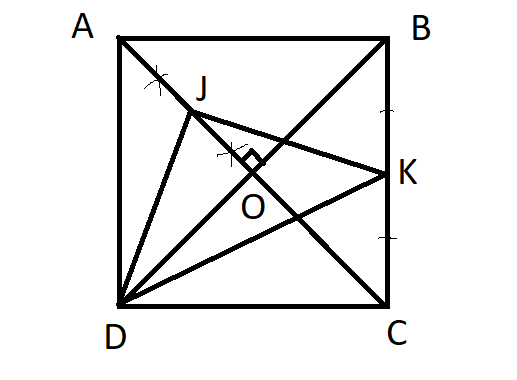


a, \(P=\left(\sqrt{x}-\dfrac{x+2}{\sqrt{x}+1}\right):\left(\dfrac{\sqrt{x}}{\sqrt{x}+1}-\dfrac{\sqrt{x}-4}{1-x}\right)\)
\(=\left(\dfrac{x+\sqrt{x}}{\sqrt{x}+1}-\dfrac{x+2}{\sqrt{x}+1}\right):\left[\dfrac{\sqrt{x}\left(\sqrt{x}-1\right)}{\left(\sqrt{x}+1\right)\left(\sqrt{x}-1\right)}+\dfrac{\sqrt{x}-4}{\left(\sqrt{x}+1\right)\left(\sqrt{x}-1\right)}\right]\)
\(=\dfrac{\sqrt{x}-2}{\sqrt{x}+1}:\dfrac{x-4}{\left(\sqrt{x}+1\right)\left(\sqrt{x}-1\right)}\)
\(=\dfrac{\sqrt{x}-2}{\sqrt{x}+1}.\dfrac{\left(\sqrt{x}+1\right)\left(\sqrt{x}-1\right)}{\left(\sqrt{x}+2\right)\left(\sqrt{x}-2\right)}\)
\(=\dfrac{\sqrt{x}-1}{\sqrt{x}+2}\)
b, \(P< \dfrac{1}{2}\Leftrightarrow\dfrac{\sqrt{x}-1}{\sqrt{x}+2}< \dfrac{1}{2}\)
\(\Leftrightarrow2\sqrt{x}-2< \sqrt{x}+2\)
\(\Leftrightarrow\sqrt{x}< 4\)
\(\Leftrightarrow0\le x< 16\)
Vậy \(0\le x< 16;x\ne1;x\ne4\).
a: ta có: \(P=\left(\sqrt{x}-\dfrac{x+2}{\sqrt{x}+1}\right):\left(\dfrac{\sqrt{x}}{\sqrt{x}+1}+\dfrac{\sqrt{x}-4}{x-1}\right)\)
\(=\dfrac{x+\sqrt{x}-x-2}{\left(\sqrt{x}+1\right)}:\dfrac{x-\sqrt{x}+\sqrt{x}-4}{\left(\sqrt{x}+1\right)\left(\sqrt{x}-1\right)}\)
\(=\dfrac{\sqrt{x}-2}{1}\cdot\dfrac{\sqrt{x}-1}{\left(\sqrt{x}-2\right)\left(\sqrt{x}+2\right)}\)
\(=\dfrac{\sqrt{x}-1}{\sqrt{x}+2}\)
c, \(P=\dfrac{\sqrt{x}-1}{\sqrt{x}+2}=\dfrac{\sqrt{x}+2-3}{\sqrt{x}+2}=1-\dfrac{3}{\sqrt{x}+2}\ge1-\dfrac{3}{2}=-\dfrac{1}{2}\)
\(\Rightarrow minP=-\dfrac{1}{2}\Leftrightarrow x=0\)
b: Để \(P< \dfrac{1}{2}\) thì \(P-\dfrac{1}{2}< 0\)
\(\Leftrightarrow\dfrac{2\sqrt{x}-2-\sqrt{x}-2}{2\left(\sqrt{x}+2\right)}< 0\)
hay x<16
Kết hợp ĐKXĐ, ta được: \(\left\{{}\begin{matrix}0\le x< 16\\x\notin\left\{1;4\right\}\end{matrix}\right.\)
Bạn thử làm xem nếu câu hỏi nào không biết thì mới hỏi nha, chứ đăng như này làm hơi dài á với lại mình thấy bạn hay đăng mấy dạng toán như này, bạn chỉ cần làm tương tự như nhưng bài trước là được :<
a. \(P=\left(\sqrt{x}-\dfrac{x+2}{\sqrt{x}+1}\right):\left(\dfrac{\sqrt{x}}{\sqrt{x}+1}-\dfrac{\sqrt{x}-4}{1-x}\right)\)
\(=\dfrac{x+\sqrt{x}-x-2}{\sqrt{x}+1}:\dfrac{x-\sqrt{x}+\sqrt{x}-4}{\left(\sqrt{x}+1\right)\left(\sqrt{x}-1\right)}\)
\(=\dfrac{\sqrt{x}-2}{\sqrt{x}+1}.\dfrac{\left(\sqrt{x}+1\right)\left(\sqrt{x}-1\right)}{x-4}=\dfrac{\left(\sqrt{x}-2\right)\left(\sqrt{x}-1\right)}{x-4}=\dfrac{\sqrt{x}-1}{\sqrt{x}+2}\)
b. Để \(P< \dfrac{1}{2}\) thì \(\dfrac{\sqrt{x}-1}{\sqrt{x}+2}< \dfrac{1}{2}\Leftrightarrow\dfrac{\sqrt{x}-1}{\sqrt{x}+2}-\dfrac{1}{2}< 0\Leftrightarrow\dfrac{\sqrt{x}-4}{2\left(\sqrt{x}+2\right)}< 0\Leftrightarrow\dfrac{\sqrt{x}-4}{2\left(\sqrt{x}+2\right)}>0\)
ta có \(\left\{{}\begin{matrix}\sqrt{x}-4< 0\\2\left(\sqrt{x}+2\right)\ge4>0\end{matrix}\right.\) \(\Rightarrow\sqrt{x}>4\Rightarrow x< 16\)
c. \(P=\dfrac{\sqrt{x}-1}{\sqrt{x}+2}=\dfrac{1-\left(\sqrt{x}+2\right)}{\sqrt{x}+2}=1-\dfrac{3}{\sqrt{x}+2}\)
Ta có với mọi \(x\ge0\) thì \(\sqrt{x}\ge0\Rightarrow\sqrt{x}+2\ge2\Rightarrow\dfrac{3}{\sqrt{x}+2}\le\dfrac{3}{2}\Rightarrow P=1-\dfrac{3}{\sqrt{x}+2}\le-\dfrac{1}{2}\)
Dấu "=" xảy ra khi \(x=0\)
Vậy \(P_{min}=-\dfrac{1}{2}\) khi \(x=0\)
d. Ta có \(Q=P\left(2\sqrt{x}+x\right)=\dfrac{\left(\sqrt{x}-1\right)\left(2\sqrt{x}+x\right)}{\sqrt{x}+2}=\dfrac{\left(\sqrt{x}-1\right)\sqrt{x}\left(2+\sqrt{x}\right)}{\sqrt{x}+2}=\sqrt{x}\left(\sqrt{x}-1\right)=x-\sqrt{x}=\left(\sqrt{x}-\dfrac{1}{2}\right)^2-\dfrac{1}{4}\ge-\dfrac{1}{4}\forall x\)
Dấu "=" xảy ra khi \(x=\dfrac{1}{4}\)
Vậy \(Q_{min}=-\dfrac{1}{4}\) khi \(x=\dfrac{1}{4}\)