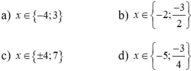
a)
2...">
Hãy nhập câu hỏi của bạn vào đây, nếu là tài khoản VIP, bạn sẽ được ưu tiên trả lời. a) đặt \(\left(x^2+x\right)\)là \(y\) ta có: \(3y^2-7y+4\)\(=0\) <=>\(\left(3y-4\right)\left(y-1\right)=0\) còn lại bạn tự xử nhé chẳng ai giải, thôi mình giải vậy! a) Đặt \(y=x^2+4x+8\),phương trình có dạng: \(t^2+3x\cdot t+2x^2=0\) \(\Leftrightarrow t^2+xt+2xt+2x^2=0\) \(\Leftrightarrow t\left(t+x\right)+2x\left(t+x\right)=0\) \(\Leftrightarrow\left(2x+t\right)\left(t+x\right)=0\) \(\Leftrightarrow\left(2x+x^2+4x+8\right)\left(x^2+4x+8+x\right)=0\) \(\Leftrightarrow\orbr{\begin{cases}x=-2\\x=-4\end{cases}}\)vậy tập nghiệm của phương trình là:S={-2;-4} b) nhân 2 vế của phương trình với 12 ta được: \(\left(6x+7\right)^2\left(6x+8\right)\left(6x+6\right)=72\) Đặt y=6x+7, ta được:\(y^2\left(y+1\right)\left(y-1\right)=72\) giải tiếp ra ta sẽ được S={-2/3;-5/3} c) \(\left(x-2\right)^4+\left(x-6\right)^4=82\) S={3;5} d)s={1} e) S={1;-2;-1/2} f) phương trình vô nghiệm \(\frac{x^2-x-6}{x-3}=\frac{x^2-3x+2x-6}{x-3}=\frac{x\left(x-3\right)+2\left(x-3\right)}{\left(x-3\right)}=x+2=0\Leftrightarrow x=-2\) \(\frac{x^2+2x-\left(3x+6\right)}{x+2}=\frac{x\left(x+2\right)-3\left(x+2\right)}{x+2}=x-3=0\Leftrightarrow x=3\) \(\frac{4}{x-2}-\left(x-2\right)=0\Leftrightarrow\frac{4}{a}-a=0\left(a=x-2\right)\Leftrightarrow\frac{4}{a}=a\Leftrightarrow a^2=4\Leftrightarrow a=\pm2\Leftrightarrow x=4\text{ hoặc 0}\) a) ĐKXĐ: x \(\ne\)3 Ta có: \(\frac{x^2-x-6}{x-3}=0\) <=> x2 - x - 6 = 0 <=> x2 - 3x + 2x - 6 = 0 <=> (x + 2)(x - 3) = 0 <=> \(\orbr{\begin{cases}x+2=0\\x-3=0\end{cases}}\) <=> \(\orbr{\begin{cases}x=-2\\x=3\left(vn\right)\end{cases}}\) Vậy S = {-2} b) ĐKXĐ: x \(\ne\)-2 Ta có: \(\frac{\left(x^2+2x\right)-\left(3x+6\right)}{x+2}=0\) <=> \(x\left(x+2\right)-3\left(x+2\right)=0\) <=> \(\left(x-3\right)\left(x+2\right)=0\) <=> \(\orbr{\begin{cases}x-3=0\\x+2=0\end{cases}}\) <=> \(\orbr{\begin{cases}x=3\\x=-2\left(vn\right)\end{cases}}\) Vậy S = {3} c) ĐKXĐ: x \(\ne\)2 Ta có: \(\frac{4}{x-2}-x+2=0\) <=> \(\frac{4-\left(x-2\right)^2}{x-2}=0\) <=> \(\left(2-x+2\right)\left(2+x-2\right)=0\) <=> \(x\left(4-x\right)=0\) <=> \(\orbr{\begin{cases}x=0\\4-x=0\end{cases}}\) <=> \(\orbr{\begin{cases}x=0\\x=4\end{cases}}\) a)\(2+\frac{3}{x-5}=1\) \(\Rightarrow\frac{3}{x-5}=-1\) \(\Rightarrow3=-x+5\) \(\Leftrightarrow x+3=5\) \(\Rightarrow x=2\) a) Ta có: \(\frac{3x-2}{6}-\frac{4-3x}{18}=\frac{4-x}{9}\) \(\Leftrightarrow\frac{3\left(3x-2\right)}{18}-\frac{4-3x}{18}-\frac{2\left(4-x\right)}{18}=0\) \(\Leftrightarrow9x-6-4+3x-\left(8-2x\right)=0\) \(\Leftrightarrow12x-10-8+2x=0\) \(\Leftrightarrow10x-18=0\) \(\Leftrightarrow10x=18\) hay \(x=\frac{9}{5}\) Vậy: \(x=\frac{9}{5}\) b) Ta có: \(\frac{2+3x}{6}-x+2=\frac{x-7}{9}\) \(\Leftrightarrow\frac{3\left(2+3x\right)}{18}-\frac{18x}{18}+\frac{36}{18}-\frac{2\left(x-7\right)}{18}=0\) \(\Leftrightarrow6+9x-18x+36-\left(2x-14\right)=0\) \(\Leftrightarrow42-9x-2x+14=0\) \(\Leftrightarrow56-11x=0\) \(\Leftrightarrow11x=56\) hay \(x=\frac{56}{11}\) Vậy: \(x=\frac{56}{11}\) c) ĐKXĐ: x∉{3;-3} Ta có: \(\frac{6-x}{x^2-9}+\frac{2}{x+3}=\frac{-5}{x-3}\) \(\Leftrightarrow\frac{6-x}{\left(x-3\right)\left(x+3\right)}+\frac{2\left(x-3\right)}{\left(x+3\right)\left(x-3\right)}=\frac{-5\left(x+3\right)}{\left(x-3\right)\left(x+3\right)}\) \(\Leftrightarrow6-x+2x-6=-5x-15\) \(\Leftrightarrow x+5x+15=0\) \(\Leftrightarrow6x=-15\) hay \(x=\frac{-5}{2}\)(tm) Vậy: \(x=\frac{-5}{2}\) d) Ta có: \(\left(5x+2\right)\left(x^2-7\right)=0\) \(\Leftrightarrow\left[{}\begin{matrix}5x+2=0\\x^2-7=0\end{matrix}\right.\Leftrightarrow\left[{}\begin{matrix}5x=-2\\x^2=7\end{matrix}\right.\Leftrightarrow\left[{}\begin{matrix}x=\frac{-2}{5}\\x=\pm\sqrt{7}\end{matrix}\right.\) Vậy: \(x\in\left\{\frac{-2}{5};\sqrt{7};-\sqrt{7}\right\}\) e) ĐKXĐ: x∉{4;-4} Ta có: \(\frac{3}{x-4}+\frac{5x-2}{x^2-16}=\frac{4}{x+4}\) \(\Leftrightarrow\frac{3\left(x+4\right)}{\left(x-4\right)\left(x+4\right)}+\frac{5x-2}{\left(x-4\right)\left(x+4\right)}-\frac{4\left(x-4\right)}{\left(x-4\right)\left(x+4\right)}=0\) \(\Leftrightarrow3x+12+5x-2-\left(4x-16\right)=0\) \(\Leftrightarrow8x+10-4x+16=0\) \(\Leftrightarrow4x+26=0\) \(\Leftrightarrow4x=-26\) hay \(x=\frac{-13}{2}\)(tm) Vậy: \(x=\frac{-13}{2}\) Nhìn sơ qua thì thấy bài 3, b thay -2 vào x rồi giải bình thường tìm m Bài 2: a) \(x+x^2=0\) \(\Leftrightarrow x\left(x+1\right)=0\) \(\Leftrightarrow\hept{\begin{cases}x=0\\x+1=0\end{cases}}\)\(\Leftrightarrow\hept{\begin{cases}x=0\\x=0-1\end{cases}}\)\(\Leftrightarrow\hept{\begin{cases}x=0\\x=-1\end{cases}}\) b) \(0x-3=0\) \(\Leftrightarrow0x=3\) \(\Rightarrow vonghiem\) c) \(3y=0\) \(\Leftrightarrow y=0\) a)<=>\(\left(x^3+x^2-2x\right)+\left(3x^2+3x-6\right)=0\) <=>\(x\left(x^2+x-2\right)+3\left(x^2+x-2\right)=0\) <=>\(\left(x^2+x-2\right)\left(x+3\right)=0\) Phương trình trên bạn tự bấm máy tính nha <=>\(\left(x-1\right)\left(x+2\right)\left(x+3\right)=0\) Đến đây tự làm đc rồi Vậy x=1 hoặc -2 hoặc -3 b)<=>\(\left(x^3-4x^2+4x\right)+\left(x^2-4x+4\right)=0\) <=>\(x\left(x^2-4x+4\right)+\left(x^2-4x+4\right)=0\) <=>\(\left(x+1\right)\left(x^2-4x+4\right)=0\) <=>\(\left(x+1\right)\left(x-2\right)^2=0\) <=>\(\orbr{\begin{cases}x=-1\\x=2\end{cases}}\) c)Câu c mik chưa làm đc Đáp án câu C: \(x^3-4x^2+5x=0\) \(\Leftrightarrow x\left(x^2-4x^2+5x\right)=0\) \(Tacó:x^2-4x+5=x^2-4x+2^2+1\) \(=\left(x-2\right)^2+1\) \(Mà\left(x-2\right)^2\ge0\) \(Nên\left(x-2\right)^2+1\ge1\) \(Khiđó:x\left(x^2-4x+5\right)=0\) \(\Leftrightarrow x=0\)

Vậy S = {0; 4}