
Hãy nhập câu hỏi của bạn vào đây, nếu là tài khoản VIP, bạn sẽ được ưu tiên trả lời.

Causes of water pollution
1) Water pollution may be caused by the intentional or unintentional disposal of hazardous chemicals and materials into a body of water.
2) Rainfall may cause polluted landscapes to disperse their poisonous materials into the water and poison the surrounding water.
3) Water pollution may also be caused by specific points or contributing factors such as large factories, oil refineries, construction sites, chemical waste management facilities, dump sites and other large scale operations that store/produce large amounts of chemical/hazardous waste.
Effects of water pollution
1) Toxic rainfall can occur in areas where water and/or air is polluted with toxic chemicals and materials.
2) Polluted water can lead to sickness, disease, infections, deformities and even death among animals and plant life.
3) Once water becomes polluted it can affect people and animals either directly through consumption or indirectly through food sources, land degradation and the overabundance of plants and algae which can cover the surface of various bodies of water making it undrinkable and affecting the animals that live in that body of water.
Solution:
The most critical step to prevent water pollution is to adopt appropriate waste management policies. Setting up of wastewater treatment plants can resolve this issue and hence we can protect our natural water resources from contamination and embrace an eco-friendly life.
HOW YOU CAN HELP
If you would like to limit the amount of pollution you produce and thus help keep the oceans, rivers and lakes clean there are a number of things you can do.
- Replace your air fresheners with eco-friendly candles, incense and/or potpourri
- Purchase environmentally friendly cleaning products that do not harm the land if they happen to be flushed or emptied into a drain
- Reduce the amount of power you use and purchase energy saving light bulbs and appliances. This helps reduce the amount of emissions being released by utility companies and your own home products.
- Conserve your water usage and don’t leave water running when you are not using it
- Reduce, recycle & reuse materials that you have purchased. Plastics and papers may be sent to the recycling bin while some of your glass materials may be able to be reused or re-purposed
- Make sure non recyclable waste is contained properly so that it does not spill into the land, street drain sewage drain
- Purchase local food that has been grown from healthy agricultural farms that don’t use polluting fertilizers and pesticides
- Purchase eco-friendly lawn fertilizers and pesticides for your own lawn in order to prevent your lawn from becoming toxic and prevent possible hazardass chemicals from entering street drains
- Recycle old clothing by giving it away to shelters and non for profit re sellers. Not only does it lower the amount of garbage you produce it also allows you go give to a cause and help the community
- Use a reusable grocery bag rather than the plastic bags offered at grocery stores when shopping for food to minimize your plastic waste
- Eliminate unnecessary mail and have your bills sent to you by email. This helps protect the trees and reduce the amount of paper you have to dispose of later
Have you ever asked yourself what ways of communication you will be using in the future?
I strongly believe there will be huge changes in the way we communicate.
Presently, we often meet face-to-face, send emails or chat online to work on our group projects.
But it’s possible that in the year 2030, we’ll be having video conferences with 3D images and Hololens Virtual Reality Glasses to interact with these people.
When we want to ask our friends to get some drinks, we often contact them by phone or social media.
However, in 20 years, super-smart phones, which can read your thoughts and automatically transfer them into text or voice messages, will be replacing those methods.
Besides, I guess telepathy will be especially popular then.
And I bet in 40 years, we will be able to understand what our pets are thinking with the help from some smart devices.
That will certainly be very amazing!!!
Mik còn 4 ngày nx à
2. Talk about cause, effect of a certain type of pollution as well as solutions to this problem (water pollution)
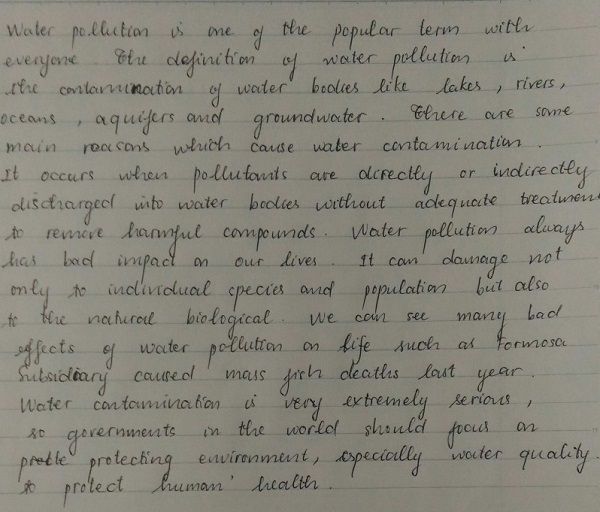
Water pollution can be defined as the contamination of a stream, river, lake, ocean or any other stretch of water, depleting water quality and making it toxic for the environment and humans. It can occur in many ways: industrial activities like dumping waste which drains in the fresh water make it polluted; or agriculture activities like using pesticides, herbicides....; and the garbage that we throw everyday. And it effects seriouslly. First, water pollution truly harms biodiversity and aquatic ecosystems, makes the creature sick or even die. Next, it has very negative effects on human health because it is the cause of many diseasessuch as diarrhea, cholera, skin infections.... or dehydration because of lacking of fresh water. Besides, it destroys environmental landscape,..etc. But we can reduce water pollution in many effective ways like reducing the amount of water we use, having green agriculture or throwing rubbish into right places..... Water pollution is a serious problem, but we can solve it if we try hard!
1.
Fifty years ago, the tools we rely upon to communicate today were only science fiction. Today, you can purchase a smartphone and make calls, surf the Web, play games, run applications and accomplish more than most speculative fiction authors dared to dream. So what's next?In the short term, we'll likely see basic cell phones slowly fade away. As smartphones become more common and less expensive, more people will adopt them. The process is gradual. As with most new technologies, a group of enthusiastic adopters lead the way. Sometimes, the general population will follow the early pioneers -- the compact disc is a good example of such technology. In other cases, the early adopters end up owning technology that becomes obsolete without ever finding wide acceptance -- like LaserDiscs.
Smartphones seem to be in the first category. Products like the Apple iPhone and Google's Android operating system have pushed the smartphone out of the world of gadget geeks and into the mass market. In 2010, the first 4G smartphone for a major carrier in the United States made an appearance. It was the HTC EVO 4G, running on Sprint's WiMAX network [source: CNET]. The 4G network allows for faster data transfer speeds than other networks.
The Internet will continue to play an increasing role in communication. Voice over Internet protocol (VoIP) already plays a large role in several communication products and services. Sites like Facebook and Twitter allow users to communicate with networks of people. With the rise of the Web, people now have a platform from which they can address the world. In the past, only celebrities and politicians could address so many people at one time. Now, anyone with an Internet connection can do the same thing.
This may lead to changes in everything from entertainment to politics. Using the Web as a communication tool, people with aspirations may be able to find an audience more easily than ever before. It may not be long until a relatively unknown person uses the Internet to win enough support to be elected president of the United States.
So far we've looked at some fairly mundane advances in communication. But what about the distant future?
2.
When people think of air pollution, most immediately picture heavy smog drifting over cities and industrial plants.
This is the first and most evident form of air pollution, but it’s not the only one.
Let’s begin today’s discussion by defining the term air pollution at a broader level. Air pollution in its most basic definition is the introduction of harmful substances into the Earth’s atmosphere.
These substances linger and cause many adverse effects. As you know, humans and other living creatures rely on the atmosphere for respiration. When air quality is dampened by pollution, immediate and longer term consequences take place.
Pollution has been known to cause allergies, disease, damage to crops, and in extreme cases, even death.
In addition, air pollution creates an imbalance in the natural gases that make up our Earth’s atmosphere. These imbalances slowly aid in the depletion of the Ozone layer, an essential region of the stratosphere that soaks up most of the sun’s damaging ultraviolet (UV) rays.
As the Ozone depletes, the rate of global warming increases. If enough air pollution clutters our environment, it creates the danger of more rapid deterioration of the Ozone layer.
You can see the trouble this may cause.
It’s important that we, as citizens of the world, fully understand the causes, effects, and possible solutions of air pollution so that we can make an educated decision for Earth’s future.
Causes
There are many causes of air pollution. For sanity’s sake, we’ve done our best to categorize them at a more general level.
Before we get into the different causes, let’s take a quick step back and look at the different variations of air pollution.
First, there’s invisible and visible air pollution. The smog you see lingering over a city is a good example of visible pollution.
Invisible pollutants aren’t as noticeable, but they can be just as deadly, if not more so. Examples of invisible pollutants include nitrogen oxides, sulfur dioxide, and carbon monoxide, to name a few.
Carbon monoxide inhaled and introduced into the human blood stream spells trouble if the pollution is a high enough concentration.
Digging down even deeper, air pollution can be split into primary and secondary pollutants.
Primary pollutants, such as sulfur dioxide, are ones directly released into the atmosphere. Secondary pollutants, like smog for example, are the result of primary pollutants intermingling with the already existing particles in the atmosphere.
Without any further ado, let’s get into some specific causes of air pollution.
1. Vehicle Exhaust Fumes.
The number one source of air pollution in city environments is vehicle exhaust fumes, which happen to release high amounts of carbon monoxide. It’s no surprise then that carbon monoxide also happens to be the largest air pollutant in the United States.
Millions of vehicles are operated on a daily basis in the US alone, each one leaving its own carbon footprint on the environment. This is why hybrid and fully electric vehicles are making a splash in the automobile marketplace.
People are looking to rely less on fossil fuels to power their cars, leading to less toxic emissions into the environment.
2. Fossil Fuel-Based Power Plants.
In addition to vehicle exhaust pollution, fossil fuels also present a wider scale problem when they’re burned for energy in power plants.
Chemicals like sulfur dioxide are released during the burning process, which travel straight into the atmosphere. These types of pollutants react with water molecules to yield something known as acid rain.
This is one of the reasons that alternative energy sources, such as nuclear, solar, and wind are being explored in greater detail. They tend to release much less pollutants into the environment to produce equivalent amounts of energy.
3. Exhaust from Industrial Plants and Factories.
Similar to exhaust being released from vehicles, heavier machinery located inside big factories and industrial plants also emit pollutants into the air.
Industrial plants can be found pretty much everywhere in the world, so the spreading of air pollution is basically global.
4. Construction and Agricultural Activities.
On a daily basis, dirt and dust is kicked up into the atmosphere from excavating and demolition type construction activities.
Switching the focus to agricultural activities, ammonia is a frequent byproduct that just so happens to be one of the most dangerous gases in our environment.
There are also plenty of nasty chemicals that get placed into the atmosphere from pesticides and fertilizers, which are being used at increasingly higher rates.
5. Natural Causes.
When people think pollution, they almost always blame other people. Let’s not forget that the Earth is one of the biggest polluters itself, though.
Volcanoes, forest fires, and dust storms are nature-born events that dump massive amounts of air pollution into the environment.
It’s often debated that humans don’t come close to volcanoes when it comes to air pollutants, but we’ll leave that for the readers to decide.
6. Household Activities.
Forget about outdoor pollution. What about the pollution that takes place inside our own homes?
Common household chemicals, notably bleach, without proper ventilation is a primary source of indoor air pollution.
Smoking tobacco through the use of cigarettes and cigars also releases toxic pollutants into the air.
It’s often easier to think of outdoor pollution as the primary danger on a wide scale level, but don’t dismiss the little everyday activities that also impact our health.
Effects
Now that we know the culprits of air pollution, let’s start discussing the harmful effects.
There are many different types of effects that air pollutants can cause. For one, there’s the human health factor to consider.
If humans are at risk, then other forms of wildlife and organic creatures are in danger as well.
Then there are the effects on the planet and its atmosphere.
In the paragraphs to follow, we’ll take a closer look at all of air pollution’s effects.
1. Accelerated Global Warming.
This is a green energy discussion, so let’s tackle this one first.
Earlier on, you learned about the Ozone layer and its role in protecting our planet. Air pollution directly accelerates the rate at which global warming happens by depleting the Ozone layer.
Global warming refers to the increased temperatures Earth continues to experience. These higher temperatures lead to the melting of the polar ice caps and icebergs, which elevates sea levels and creates concern for the human race.
2. Human Respiratory and Heart Concerns.
Air pollution is known to cause irritation in the eyes, lungs, nose, and throat. It creates respiratory problems and exacerbates existing conditions such as asthma and emphysema.
When continually exposed to air pollution, humans become at higher risk for cardiovascular disease. Air filled with toxins can have a number of adverse effects on the arteries, and have even been a contributor to heart attacks.
3. Wildlife Endangerment.
Most diseases and conditions that humans are susceptible to, animals are as well. Air pollution creates many of the same issues that humans face.
Heavily polluted areas force inhabitants to seek new homes, which can negatively impact the ecosystem.
Toxic chemicals, which we’ll discuss in the next bullet, also deposit over surfaces of water that can lead to the endangerment of marine life animals.
4. Acid Rain.
When air pollution, specifically sulfur oxides and nitrogen oxides, are released into sky through fossil fuel burning, it creates the phenomenon known as acid rain.
Water, high in the atmosphere, combines with these chemicals and becomes acidic in nature. It then scatters the ground, disguised as normal rainfall.
Acid rain has been known to cause harm to humans and animals alike, and even damage crops.
Solutions
Up until this point, we’ve covered all the bad of air pollution. Now let’s get onto the good.
Well, there’s actually not much good to say for air pollution, but there are a number of positive ways it can be dealt with.
Understanding the causes and effects proves to be important so that we can determine how best to combat it.
Reducing the use of fossil fuel powered automobiles is clearly something that can help. Same with finding unique ways to reduce energy consumption.
Let’s dig a little deeper into common solutions for preventing and minimizing air pollution.
1. Minimize the Use of Fossil Fuel Powered Automobiles.
As a leading contributor to air pollution, it only makes sense that a vehicle-based solution appears first on this list.
One way to do this is by switching to a hybrid vehicle, or better yet, one that runs on fully electric.
Other ways include taking public transportation, carpooling with friends and colleagues, or even riding a bike to your destination.
2. Be Mindful of Energy Consumption.
When you’re leaving home, be sure to turn off the lights, TV, and any other electronic appliances.
Fossil fuel plants are a major cause of air pollutants, and the less energy you need, the less we have to rely on those plants to generate electricity.
This also means turning to energy efficient devices when possible. Fluorescent lightbulbs over the course of their lifespan can reduce energy consumption while adding significant savings to your pocket.
3. Become a...
Nhiều lỗi quá:) Sửa:
Water pollution can be defined as the contamination of a stream, river, lake, ocean or any other water stretch, depleting water quality and making it toxic for the environment and humans. It can occur in many ways: industrial activities like dumping waste which drains in the freshwater make it polluted, or agriculture activities like pesticides, herbicides, and the garbage that we throw every day. And it affects seriously. First, water pollution truly harms biodiversity, and aquatic ecosystems make the creature sick or even die. Next, it has very adverse effects on human health because it is the cause of many diseases such as diarrhoea, cholera, skin infections or dehydration because of lacking freshwater. Besides, it destroys the environmental landscape, etc. But we can reduce water pollution in many practical ways like reducing the amount of water we use, having green agriculture or throwing rubbish into the right places. Water pollution is a severe problem, but we can solve it if we try hard!