
Hãy nhập câu hỏi của bạn vào đây, nếu là tài khoản VIP, bạn sẽ được ưu tiên trả lời.
 đạt giá trị nhỏ nhất
1) Thay m=2 vào (1), ta được:
\(x^2-2\cdot3x+16-8=0\)
\(\Leftrightarrow x^2-6x+8=0\)
\(\Leftrightarrow\left(x-2\right)\left(x-4\right)=0\)
\(\Leftrightarrow\left[{}\begin{matrix}x-2=0\\x-4=0\end{matrix}\right.\Leftrightarrow\left[{}\begin{matrix}x=2\\x=4\end{matrix}\right.\)
Vậy: Khi m=2 thì (1) có hai nghiệm phân biệt là: \(x_1=2\); \(x_2=4\)
b) Ta có: \(\Delta=4\cdot\left(2m-1\right)^2-4\cdot1\cdot\left(8m-8\right)\)
\(\Leftrightarrow\Delta=4\cdot\left(4m^2-4m+1\right)-4\left(8m-8\right)\)
\(\Leftrightarrow\Delta=16m^2-16m+4-32m+32\)
\(\Leftrightarrow\Delta=16m^2-48m+36\)
\(\Leftrightarrow\Delta=\left(4m\right)^2-2\cdot4m\cdot6+6^2\)
\(\Leftrightarrow\Delta=\left(4m-6\right)^2\)
Để phương trình có hai nghiệm phân biệt thì \(\left(4m-6\right)^2>0\)
mà \(\left(4m-6\right)^2\ge0\forall m\)
nên \(4m-6\ne0\)
\(\Leftrightarrow4m\ne6\)
hay \(m\ne\dfrac{3}{2}\)
Vậy: Để phương trình có hai nghiệm phân biệt thì \(m\ne\dfrac{3}{2}\)
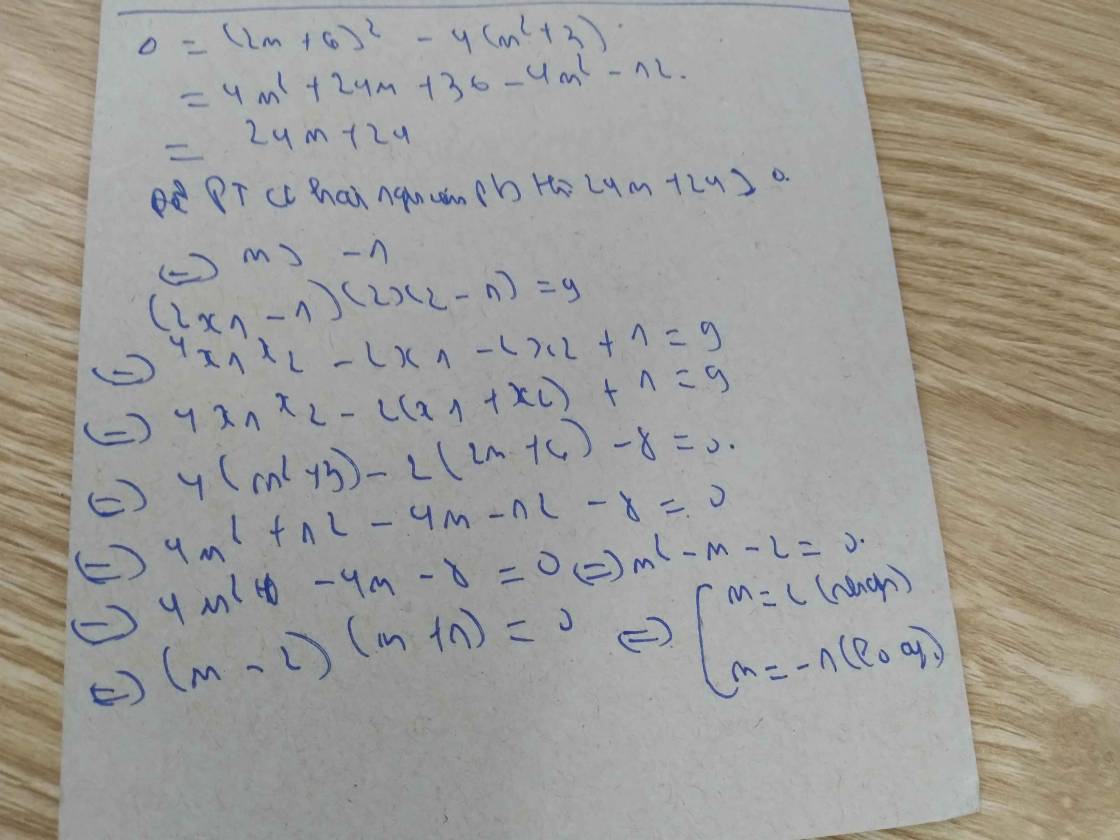
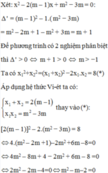
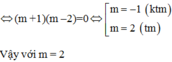
Sửa đề: \(x_1^2+x_2^2=5\)
\(\Delta=\left(2m-1\right)^2-4\cdot1\cdot\left(4m-4\right)\)
\(=4m^2-4m+1-16m+16=4m^2-20m+17\)
\(=4m^2-2\cdot2m\cdot5+25-8=\left(2m-5\right)^2-8\)
Để phương trình có hai nghiệm phân biệt thì \(\left(2m-5\right)^2-8>0\)
=>\(\left(2m-5\right)^2>8\)
=>\(\left[\begin{array}{l}2m-5>2\sqrt2\\ 2m-5<-2\sqrt2\end{array}\right.\Rightarrow\left[\begin{array}{l}2m>2\sqrt2+5\\ 2m<-2\sqrt2+5\end{array}\right.\Rightarrow\left[\begin{array}{l}m>\frac{2\sqrt2+5}{2}\\ m<\frac{-2\sqrt2+5}{2}\end{array}\right.\)
Theo Vi-et, ta có: \(x_1+x_2=-\frac{b}{a}=2m-1;x_1x_2=\frac{c}{a}=4m-4\)
\(x_1^2+x_2^2=5\)
=>\(\left(x_1+x_2\right)^2-2x_1x_2=5\)
=>\(\left(2m-1\right)^2-2\left(4m-4\right)=5\)
=>\(4m^2-4m+1-8m+8=5\)
=>\(4m^2-12m+9=5\)
=>\(\left(2m-3\right)^2=5\)
=>\(\left[\begin{array}{l}2m-3=\sqrt5\\ 2m-3=-\sqrt5\end{array}\right.\Rightarrow\left[\begin{array}{l}2m=3+\sqrt5\\ 2m=3-\sqrt5\end{array}\right.\Rightarrow m=\frac{3\pm\sqrt5}{2}\) (nhận)
Ta có \(\Delta'=\left(m-2\right)^2+m-2\)
\(=m^2-4m+4+m-2\)
\(=m^2-3m+2\)
Để pt có 2 nghiệm phân biệt thì \(\Delta'>0\Leftrightarrow\orbr{\begin{cases}m< 1\\m>2\end{cases}}\)
Teo Vi-et \(\hept{\begin{cases}x_1+x_2=2\left(m-2\right)\\x_1x_2=-m+2\end{cases}}\)
Ta có \(x_1+2x_2=2\)
\(\Leftrightarrow\left(x_1+x_2\right)+x_2=2\)
\(\Leftrightarrow2\left(m-2\right)+x_2=2\)
\(\Leftrightarrow2m-4+x_2=2\)
\(\Leftrightarrow x_2=6-2m\)
Ta có \(x_1+x_2=2\left(m-2\right)\)
\(\Leftrightarrow x_1+6-2m=2m-4\)
\(\Leftrightarrow x_1=4m-10\)
Thay vào tích x1 . x2 được
\(x_1x_2=-m+2\)
\(\Leftrightarrow\left(4m-10\right)\left(6-2m\right)=-m+2\)
\(\Leftrightarrow24m-8m^2-60+20m=-m+2\)
\(\Leftrightarrow8m^2-45m+62=0\)
Có \(\Delta=41\)
\(\Rightarrow\orbr{\begin{cases}m=\frac{45-\sqrt{41}}{16}\left(tm\right)\\m=\frac{45+\sqrt{41}}{16}\left(tm\right)\end{cases}}\)
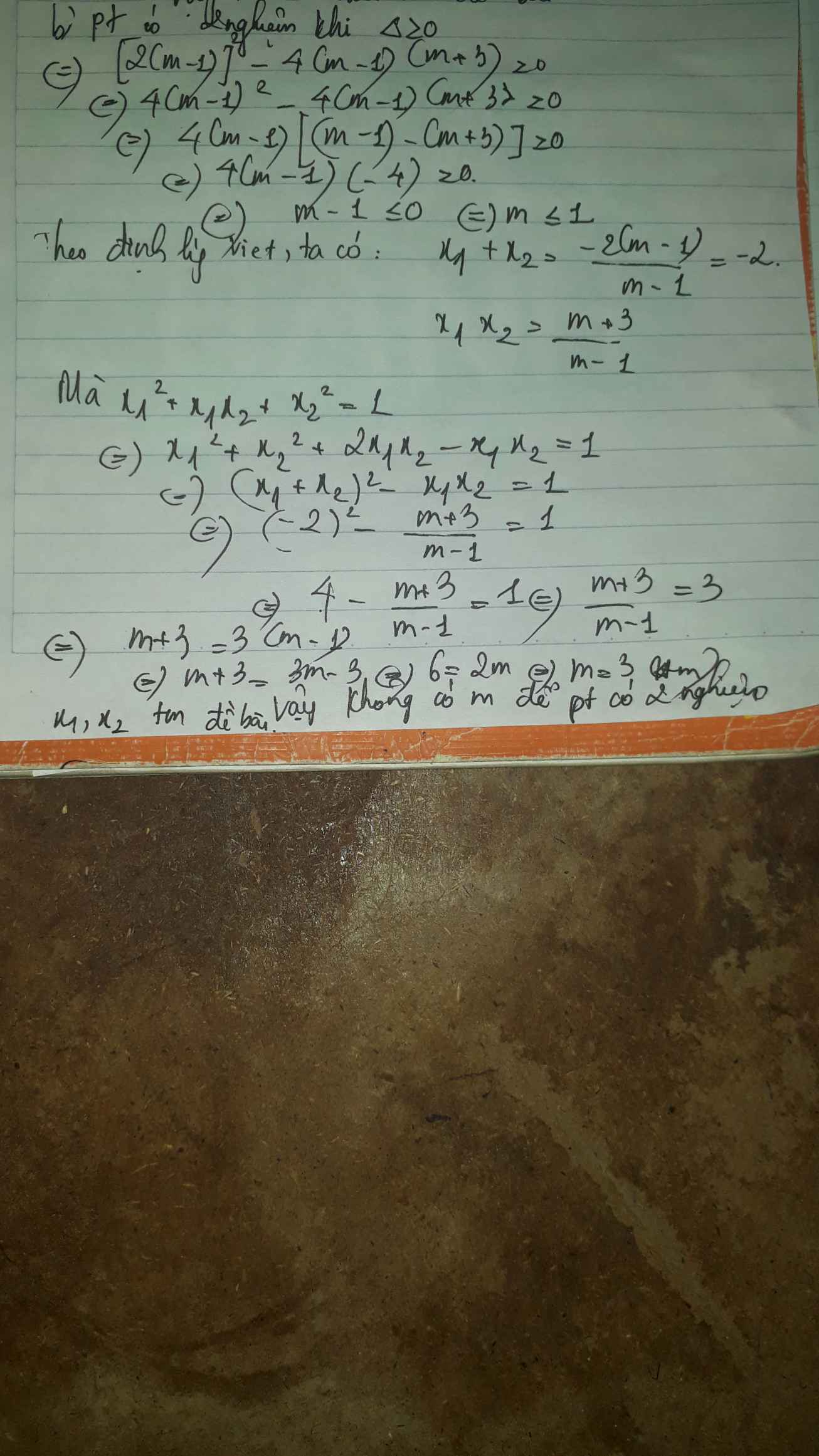
b) phương trình có 2 nghiệm \(\Leftrightarrow\Delta'\ge0\)
\(\Leftrightarrow\left(m-1\right)^2-\left(m-1\right)\left(m+3\right)\ge0\)
\(\Leftrightarrow m^2-2m+1-m^2-3m+m+3\ge0\)
\(\Leftrightarrow-4m+4\ge0\)
\(\Leftrightarrow m\le1\)
Ta có: \(x_1^2+x_1x_2+x_2^2=1\)
\(\Leftrightarrow\left(x_1+x_2\right)^2-2x_1x_2=1\)
Theo viet: \(\left\{{}\begin{matrix}x_1+x_2=-\dfrac{b}{a}=2\left(m-1\right)\\x_1x_2=\dfrac{c}{a}=m+3\end{matrix}\right.\)
\(\Leftrightarrow\left[-2\left(m-1\right)^2\right]-2\left(m+3\right)=1\)
\(\Leftrightarrow4m^2-8m+4-2m-6-1=0\)
\(\Leftrightarrow4m^2-10m-3=0\)
\(\Leftrightarrow\left[{}\begin{matrix}m_1=\dfrac{5+\sqrt{37}}{4}\left(ktm\right)\\m_2=\dfrac{5-\sqrt{37}}{4}\left(tm\right)\end{matrix}\right.\Rightarrow m=\dfrac{5-\sqrt{37}}{4}\)