
Hãy nhập câu hỏi của bạn vào đây, nếu là tài khoản VIP, bạn sẽ được ưu tiên trả lời.

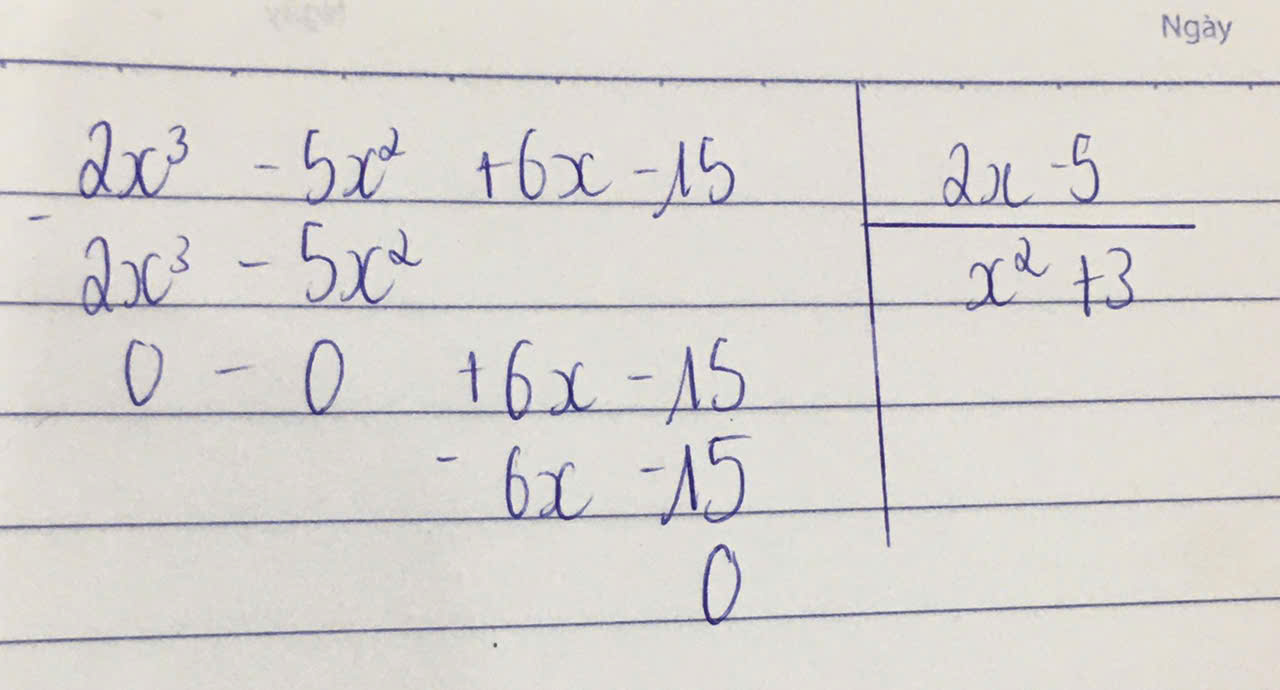
a,(\(6x-5x^2-15+2x^3:\left(2x-5\right)\)
\(\left(2x^3-5x^2+6x-15\right):\left(2x-5\right)\)
a: Đặt f(x)=0
=>3/4x=1/8
=>x=1/8:3/4=1/8x4/3=4/24=1/6
b: Đặt H(x)=0
=>-5x+30=0
=>x=6
c: Đặt G(x)=0
=>(x-3)(x-4)=0
=>x=3 hoặc x=4
d: Đặt K(x)=0
=>(x-9)(x+9)=0
=>x=9 hoặc x=-9
e: Đặt M(x)=0
=>(x+8)(x-1)=0
=>x=-8 hoặc x=1
a: \(H\left(x\right)=-x^5+x^4-3x^3+2x^2-5x-2+x^5-x^4+3x^3-2x^2+3x+11\)
=-2x+9
Đặt H(x)=0
=>-2x+9=0
hay x=-9/2
b: Vì H(9)<>0 nên x=9 ko là nghiệm của H(x)
a: H(x)=−x5+x4−3x3+2x2−5x−2+x5−x4+3x3−2x2+3x+11�(�)=−�5+�4−3�3+2�2−5�−2+�5−�4+3�3−2�2+3�+11
=-2x+9
Đặt H(x)=0
=>-2x+9=0
hay x=-9/2
b: Vì H(9)<>0 nên x=9 ko là nghiệm của H(x)
a) \(2^3:\left|x-2\right|=2\)
\(\Leftrightarrow8:\left|x-2\right|=2\)
\(\Leftrightarrow\left|x-2\right|=8:2\)
\(\Leftrightarrow\left|x-2\right|=4\)
Xét trường hợp 1: \(x-2=4\)
\(\Rightarrow x=4+2\)
\(\Rightarrow x=6\)
Xét trường hợp 2: \(x-2=-4\)
\(\Rightarrow x=-4+2\)
\(\Rightarrow x=-\left(4-2\right)\)
\(\Rightarrow x=-2\)
Vậy \(x=6\) hoặc \(x=-2\)
b)
Thêm nữa câu a) Tính: M(x) + N(x)+ P(x)
B) Tính M(x) - N (x) - P(x)
ok rồi giúp mình với nha
`@` `\text {Ans}`
`\downarrow`
`a)`
`(x-2)(4-3x)`
Để `x` là `1` nghiệm của đa thức, x phải thỏa mãn giá trị sao cho đa thức `=0`
`(x-2)(4-3x)=0`
`=>`\(\left[{}\begin{matrix}x-2=0\\4-3x=0\end{matrix}\right.\)
`=>`\(\left[{}\begin{matrix}x=2\\3x=4\end{matrix}\right.\)
`=>`\(\left[{}\begin{matrix}x=2\\x=\dfrac{4}{3}\end{matrix}\right.\)
Vậy, nghiệm của đa thức là `x \in {2; 4/3}`
`b)`
`x^2 - 4 =0`
`=> x^2=0+4`
`=> x^2=4`
`=> x^2=(+-2)^2`
`=> x=+-2`
Vậy, nghiệm của đa thức là `x \in {2; -2}`
`c)`
`x^2 + \sqrt {7}=0`
`=> x^2 = 0 - \sqrt {7}`
`=> x^2 = -\sqrt {7} (\text {vô lí})`
Vậy, đa thức không có nghiệm (vô nghiệm)
`d)`
`x^2+5x=0`
`=> x(x+5)=0`
`=>`\(\left[{}\begin{matrix}x=0\\x+5=0\end{matrix}\right.\)
`=>`\(\left[{}\begin{matrix}x=0\\x=-5\end{matrix}\right.\)
Vậy, nghiệm của đa thức là `x \in {0; -5}`
`e)`
\(x^2+5x-6=0\)
`=> x^2-x+6x-6=0`
`=> (x^2-x)+(6x-6)=0`
`=> x(x-1)+ 6(x-1)=0`
`=> (x+6)(x-1)=0`
`=>`\(\left[{}\begin{matrix}x+6=0\\x-1=0\end{matrix}\right.\)
`=>`\(\left[{}\begin{matrix}x=-6\\x=1\end{matrix}\right.\)
Vậy, nghiệm của đa thức là `x \in {-6; 1}`
`f)`
\(x^2+x+1=0\)
`x^2 >= 0 AA x`
`=> x^2+x+1 >= 1 AA x`
`1 \ne 0`
`=>` Đa thức vô nghiệm
` h)`
\(7x^2+11x+4=0\)
`=> 7x^2+7x+4x+4=0`
`=> (7x^2+7x)+(4x+4)=0`
`=> 7x(x+1)+4(x+1)=0`
`=> (7x+4)(x+1)=0`
`=>`\(\left[{}\begin{matrix}7x+4=0\\x+1=0\end{matrix}\right.\)
`=>`\(\left[{}\begin{matrix}7x=-4\\x=-1\end{matrix}\right.\)
`=>`\(\left[{}\begin{matrix}x=-\dfrac{4}{7}\\x=-1\end{matrix}\right.\)
Vậy, nghiệm của đa thức là `x \in {-4/7; -1}.`
`\text {#KaizuulvG}`
a, (\(x-2\))(4-3\(x\)) =0
\(\left[{}\begin{matrix}x-2=0\\4-3x=0\end{matrix}\right.\)
\(\left[{}\begin{matrix}x=2\\3x=4\end{matrix}\right.\)
\(\left[{}\begin{matrix}x=2\\x=\dfrac{4}{3}\end{matrix}\right.\)
\(x\in\){ \(\dfrac{4}{3}\); 2}
b, \(x^2-4\) = 0
\(x^2\) = 4
\(x\) = \(\mp\) 2
Vậy \(x\) = { -2; 2}
c, \(x^2\) + \(\sqrt{7}\) = 0
\(x^2\) ≥ 0 ⇒ \(x^2\) + \(\sqrt{7}\) ≥ \(\sqrt{7}\)
\(x\) \(\in\) \(\varnothing\)