
Viết một bài thơ nói về sở thích điểm mạnh và điểm yếu
Viết một bài thơ nói về Sở trường điểm mạnh điểm yếu của em
K
Khách
Hãy nhập câu hỏi của bạn vào đây, nếu là tài khoản VIP, bạn sẽ được ưu tiên trả lời.

8 tháng 11 2024
trả lời đi chứ mình ra đề nhưng cũng hong biết trả lời vô tư
GH
1
QT
Quoc Tran Anh Le
CTVVIP
22 tháng 4
Truyện Kiều là một kiệt tác văn học nổi tiếng của đại thi hào Nguyễn Du, được sáng tác vào đầu thế kỉ XIX. Tác phẩm có tên đầy đủ là “Đoạn trường tân thanh”, được viết bằng thể thơ lục bát gồm 3254 câu, dựa trên cốt truyện “Kim Vân Kiều truyện” của Trung Quốc nhưng đã được Nguyễn Du sáng tạo lại một cách sâu sắc và mang đậm bản sắc dân tộc. Nội dung chính của Truyện Kiều kể về cuộc đời đầy biến cố của Thúy Kiều, một người con gái tài sắc vẹn toàn nhưng phải chịu nhiều đau khổ, lưu lạc suốt mười lăm năm vì chữ hiếu và những bất công trong xã hội phong kiến. Qua đó, tác phẩm phản ánh hiện thực xã hội tàn bạo, chà đạp lên số phận con người, đồng thời thể hiện niềm cảm thương sâu sắc của tác giả đối với những con người tài hoa nhưng bạc mệnh. Bên cạnh giá trị hiện thực, Truyện Kiều còn mang giá trị nhân đạo to lớn, đề cao quyền sống, khát vọng tình yêu, hạnh phúc và tự do của con người. Về nghệ thuật, tác phẩm đạt đến đỉnh cao với ngôn ngữ giàu hình ảnh, tinh tế, sử dụng điêu luyện thể thơ lục bát và nhiều biện pháp tu từ đặc sắc. Nhờ những giá trị nội dung và nghệ thuật đó, Truyện Kiều không chỉ là niềm tự hào của văn học Việt Nam mà còn có sức sống lâu bền trong lòng người đọc qua nhiều thế hệ.
8 tháng 11 2024
Cụ thể :
+ Năm 2000 dân số dưới 15 tuổi chiếm 36,4% đến năm 2020 con số này đã giảm còn 28,7%.
+Nhóm dân số từ 15 đến 64 tuổi năm 2000 là 59,1 đến năm 2020laf 65,6%
+ Dân số từ 65 tuổi trở lên năm 2000 là 4,5% , năm 2020 là 5,7 %
8 tháng 11 2024
S A B C D O M N d I P
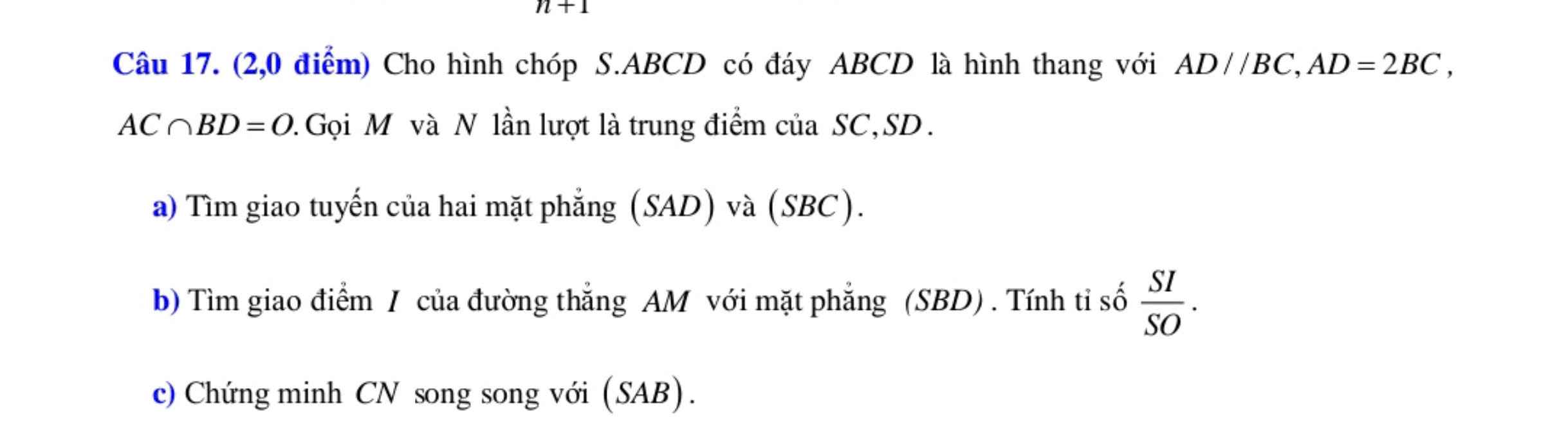
a/ Qua S dựng đường thẳng d//AD
d//AD; \(S\in\left(SAD\right)\Rightarrow d\in\left(SAD\right)\)
d//AD;AD//BC => d//BC mà \(S\in\left(SBC\right)\Rightarrow d\in\left(SBC\right)\)
=> d chính là giao tuyến của (SAD) và (SBC)
b/
Trong (SAC) gọi I là giao của AM với SO
\(I\in SO;SO\in\left(SBD\right)\Rightarrow I\in\left(SBD\right)\)
=> I là giao của AM với (SBD)
Ta có BC//AD \(\Rightarrow\dfrac{OC}{OA}=\dfrac{BC}{AD}=\dfrac{1}{2}\)
2 tg SAM và tg CAM có chung đường cao từ A->SC và MS=MC nên \(S_{SAM}=S_{CAM}=S\)
2 tg AMO và tg CMO có chung đường cao từ M->AC nên
\(\dfrac{S_{AMO}}{S_{CMO}}=\dfrac{OA}{OC}=2\Rightarrow\dfrac{S_{AMO}}{2}=S_{CMO}=\dfrac{S_{AMO}+S_{CMO}}{2+1}=\dfrac{S_{CAM}}{3}\)
\(\Rightarrow\dfrac{S_{AMO}}{S_{CAM}}=\dfrac{S_{AMO}}{S_{SAM}}=\dfrac{2}{3}\)
2 tg AMO và tg SAM có chung AM nên
\(\dfrac{S_{AMO}}{S_{SAM}}=\) đường cao từ O->AM/đường cao từ S->AM \(=\dfrac{2}{3}\)
2 tg OMI và tg SMI có chung IM nên
\(\dfrac{S_{OMI}}{S_{SMI}}=\)đường cao từ O->AM/đường cao từ S->AM\(=\dfrac{2}{3}\)
2tg OMI và tg SMI có chung đường cao từ M->SO nên
\(\dfrac{S_{OMI}}{S_{SMI}}=\dfrac{OI}{SI}=\dfrac{2}{3}\)
\(\Rightarrow\dfrac{OI}{2}=\dfrac{SI}{3}=\dfrac{OI+SI}{2+3}=\dfrac{SO}{5}\Rightarrow\dfrac{SI}{SO}=\dfrac{3}{5}\)
c/
Gọi P là trung điểm của SA, Xét tg SAD có
PA=PS; ND=NS (gt) => PN là đường trung bình của tg SAD
=> PN//AD và \(PN=\dfrac{1}{2}AD\)
Ta có
PN//AD; AD//BC => PN//BC
\(AD=2BC\Rightarrow BC=\dfrac{1}{2}AD\)
=> PN//BC và \(PN=BC=\dfrac{1}{2}AD\)
=> BCNP là hbh (Tứ giác có 1 cặp cạnh đối // và bằng nhau là hbh)
=> CN//BP (cạnh đối hbh) mà \(BP\in\left(SAB\right)\) => CN//(SAB)
9 tháng 11 2024
a.
Qua S kẻ đường thẳng d song song AD và BC
Do \(\left\{{}\begin{matrix}S\in\left(SAD\right)\\S\in d\\d||AD\end{matrix}\right.\) \(\Rightarrow d\in\left(SAD\right)\)
\(\left\{{}\begin{matrix}S\in\left(SBC\right)\\S\in d\\d||BC\end{matrix}\right.\) \(\Rightarrow d\in\left(SBC\right)\)
\(\Rightarrow d=\left(SAD\right)\cap\left(SBC\right)\)
b.
Trong mp (SAC), nối AM cắt SO tại I
\(\left\{{}\begin{matrix}O\in BD\in\left(SBD\right)\\S\in\left(SBD\right)\end{matrix}\right.\) \(\Rightarrow SO\in\left(SBD\right)\)
\(I\in SO\Rightarrow I\in\left(SBD\right)\)
\(\Rightarrow I=AM\cap\left(SBD\right)\)
Do AD song song BC, áp dụng định lý Thales:
\(\dfrac{OA}{OC}=\dfrac{AD}{BC}=2\) \(\Rightarrow OA=2OC=2\left(AC-OA\right)\Rightarrow\dfrac{OA}{AC}=\dfrac{2}{3}\)
Áp dụng định lý Menelaus:
\(\dfrac{OA}{AC}.\dfrac{CM}{MS}.\dfrac{SI}{IO}=1\Leftrightarrow\dfrac{2}{3}.1.\dfrac{SI}{IO}=1\)
\(\Rightarrow2SI=3IO=3\left(SO-SI\right)\)
\(\Rightarrow5SI=3SO\Rightarrow\dfrac{SO}{SI}=\dfrac{3}{5}\)
8 tháng 11 2024
S A B C D E F I K M
a/
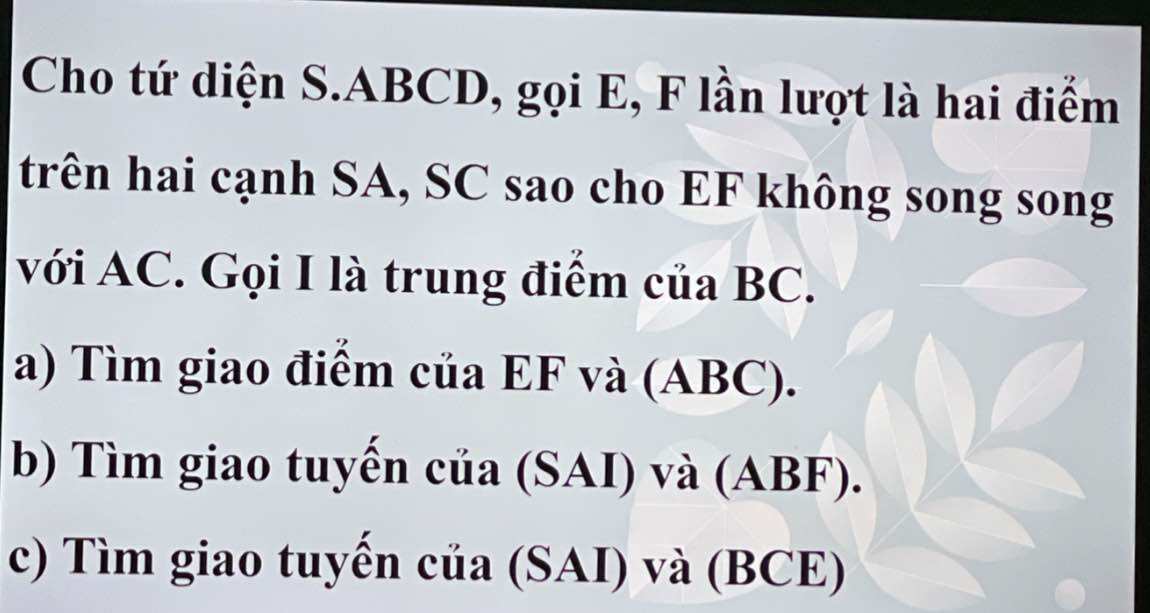
Trong mp(SAC) Gọi K là giao của EF và AC
\(K\in EF\)
\(K\in AC;AC\in\left(ABC\right)\Rightarrow K\in\left(ABC\right)\)
=> K là giao của EF với (ABC)
b/
Trong mp (SBC), Gọi M là giao của SI với BF
\(M\in SI;SI\in\left(SAI\right)\Rightarrow M\in\left(SAI\right)\)
\(M\in BF;BF\in\left(ABF\right)\Rightarrow M\in\left(ABF\right)\)
\(A\in\left(SAI\right);A\in\left(ABF\right)\)
=> AM là giao tuyến giữa (SAI) và (ABF)
c/
\(I\in\left(SAI\right)\)
\(I\in BC;BC\in\left(BCE\right)\Rightarrow I\in\left(BCE\right)\)
\(E\in SA;SA\in\left(SAI\right)\Rightarrow E\in\left(SAI\right)\)
\(E\in\left(BCE\right)\)
=> IE là giao tuyến giữa (SAI) và (BCE)
PN
18 tháng 11 2024
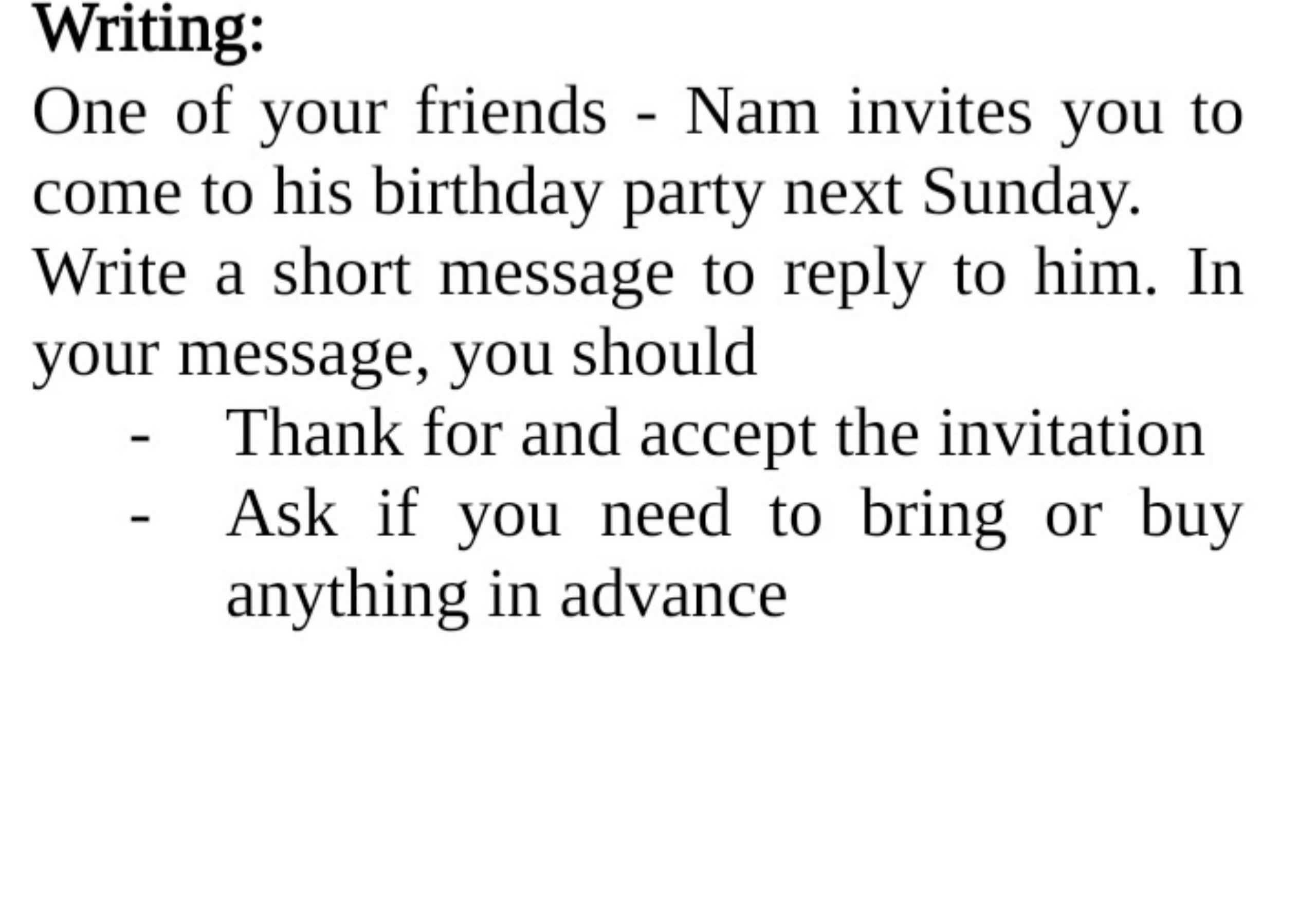
Hi Nam,
I'm so excited about your birthday party! I still remember that time we went to the amusement park. Thanks for inviting me. Let me know if I can bring anything, like my favorite board game.
Can't wait to celebrate! (Tên của bạn)
Em thích đọc sách, vẽ tranh
Thích nghe chim hót trên cành mỗi trưa
Thích nhìn nắng sớm đong đưa
Thích gom mơ ước cho vừa tuổi thơ
Sở trường của em là chăm
Làm bài cẩn thận, âm thầm cố lên
Bạn bè chưa hiểu gì thêm
Em vui chỉ lại, dịu êm thật thà
Điểm mạnh là biết chan hòa
Yêu thầy, quý bạn, thật thà, chăm ngoan
Việc gì đã hứa rõ ràng
Em luôn cố gắng hoàn thành đến nơi
Nhưng em cũng có điểm rồi
Đôi khi nhút nhát trước nơi đông người
Có khi chậm một tiếng cười
Có khi còn ngại nói lời xung phong
Em đang sửa đổi từng ngày
Tự tin, mạnh dạn, dựng xây chính mình
Điểm mạnh em sẽ giữ gìn
Điểm yếu em sẽ luyện thành tiến lên