
giải giúp mình voiii mình đang cần gấp ạ tối nay mình phải nộp rồi
Hãy nhập câu hỏi của bạn vào đây, nếu là tài khoản VIP, bạn sẽ được ưu tiên trả lời.

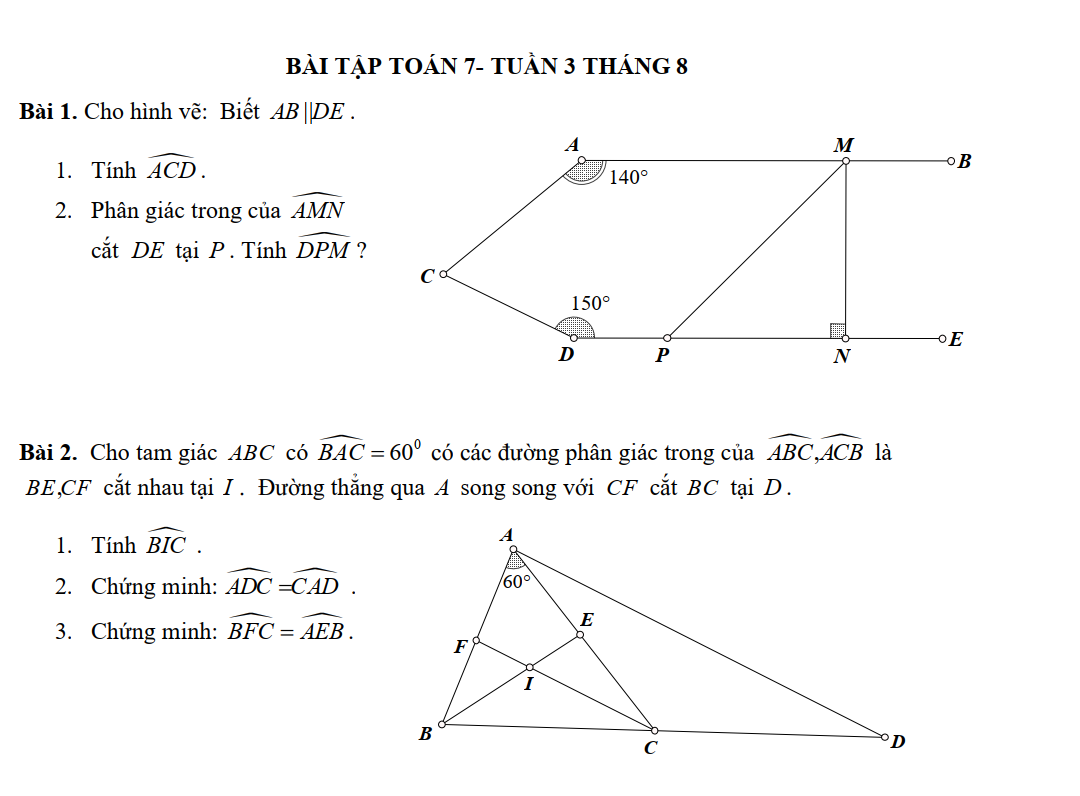
Bài 1:
1) Kẻ tia Cx//AB//DE
Ta có: Cx//AB
\(\Rightarrow\widehat{BAC}+\widehat{ACx}=180^0\)(2 góc trong cùng phía)
\(\Rightarrow\widehat{ACx}=180^0-\widehat{BAC}=180^0-140^0=40^0\)
Ta có: Cx//DE
\(\Rightarrow\widehat{xCD}+\widehat{CDE}=180^0\)( 2 góc trong cùng phía)
\(\Rightarrow\widehat{xCD}=180^0-\widehat{CDE}=180^0-150^0=30^0\)
\(\Rightarrow\widehat{ACD}=\widehat{ACx}+\widehat{xCD}=40^0+30^0=70^0\)
2) Ta có AB//DE(gt)
Mà DE⊥MN
=> AB⊥MN =>\(\widehat{AMN}=90^0\Rightarrow\dfrac{1}{2}\widehat{AMN}=45^0\Rightarrow\widehat{AMP}=45^0\) (do MP là tia phân giác \(\widehat{AMN}\))
Ta có AB//DE
=> \(\widehat{AMP}+\widehat{DPM}=180^0\) (2 góc trong cùng phía)
\(\Rightarrow\widehat{DPM}=180^0-\widehat{AMP}=180^0-45^0=135^0\)
The Tay, with local groups Pa dí, Thổ, Ngan, Phén, Thu Lao, is an ethnic group of 54 ethnic groups in Viet Nam. Tay people speak Tay, a Tai dialect of the Tai-Kadai language. Tay people live mainly in lowland areas of northern Vietnam. The Tay was previously known as the Tho (although this name is now used to refer to a different ethnic group, see Turks). Tay people have the second largest population in Vietnam. Tay people, Nung have a close relationship with the Choang people in China.Tay people mainly reside in the northern midland and mountainous provinces (1,400,519 people in 1999). In addition, in the recent time, the Tay also migrated to some provinces in the Central Highlands like Dak Lak and Lam Dong.The Tay are usually at the foot of the mountain or along the stream. The name is often referred to by the name of hills, fields, rivers. Each village has 15 to 20 houses. Large villages divided into many small villages.Tay dressed in indigo. Traditional Tay costumes are made from self-made cotton yarn, dyed indigo on men's and women's clothes, almost without decorative pattern. Tay clothing can be considered one of the simplest outfits of 54 ethnic groups. The costume is simple but meaningful.Then singing, singing, singing sli are used in various activities, popular folk songs of the Tay. Musical instruments such as the Micro, Shake. Chess is an instrument that is present in all spiritual activities of the Tay, such as soul in the folk dance of the Tay. In this life, the sex acts as a means of communicating bold identity.Traditional houses are usually on stilts, lands and roofs with grass and some border areas have defense types. In the house to distinguish male rooms outside, women in the chamber. Most popular are 3-room, 2-roofed houses (no chop), logs of land or bushes, surrounding woods, roofs of grass, picturesque Tay people settle in groups of about 15 to 20 households. Tay people worship ancestors and animals. The Tay ancestors' altar is placed in the middle of the house and made into a private space and revered. Pregnant women and their newborns are not allowed to sit or lie on chairs or beds in front of the altar. In the Tay religion, the most important feast day of the Tay people is usually the last day of the lunar month.The life of the Tay is often associated with nature, so the food and foodstuff of the Tay people are products obtained from production activities in areas with forests, rivers, streams and hills surrounding. Some famous dishes are: sticky egg rolls, sticky rice balls, sour bamboo shoots, stigma.
The Tay, with local groups Pa dí, Thổ, Ngan, Phén, Thu Lao, is an ethnic group of 54 ethnic groups in Viet Nam. Tay people speak Tay, a Tai dialect of the Tai-Kadai language. Tay people live mainly in lowland areas of northern Vietnam. The Tay was previously known as the Tho (although this name is now used to refer to a different ethnic group, see Turks). Tay people have the second largest population in Vietnam. Tay people, Nung have a close relationship with the Choang people in China.Tay people mainly reside in the northern midland and mountainous provinces (1,400,519 people in 1999). In addition, in the recent time, the Tay also migrated to some provinces in the Central Highlands like Dak Lak and Lam Dong.The Tay are usually at the foot of the mountain or along the stream. The name is often referred to by the name of hills, fields, rivers. Each village has 15 to 20 houses. Large villages divided into many small villages.Tay dressed in indigo. Traditional Tay costumes are made from self-made cotton yarn, dyed indigo on men's and women's clothes, almost without decorative pattern. Tay clothing can be considered one of the simplest outfits of 54 ethnic groups. The costume is simple but meaningful.Then singing, singing, singing sli are used in various activities, popular folk songs of the Tay. Musical instruments such as the Micro, Shake. Chess is an instrument that is present in all spiritual activities of the Tay, such as soul in the folk dance of the Tay. In this life, the sex acts as a means of communicating bold identity.Traditional houses are usually on stilts, lands and roofs with grass and some border areas have defense types. In the house to distinguish male rooms outside, women in the chamber. Most popular are 3-room, 2-roofed houses (no chop), logs of land or bushes, surrounding woods, roofs of grass, picturesque Tay people settle in groups of about 15 to 20 households. Tay people worship ancestors and animals. The Tay ancestors' altar is placed in the middle of the house and made into a private space and revered. Pregnant women and their newborns are not allowed to sit or lie on chairs or beds in front of the altar. In the Tay religion, the most important feast day of the Tay people is usually the last day of the lunar month.The life of the Tay is often associated with nature, so the food and foodstuff of the Tay people are products obtained from production activities in areas with forests, rivers, streams and hills surrounding. Some famous dishes are: sticky egg rolls, sticky rice balls, sour bamboo shoots, stigma.
THAM KHẢO
Con cái có chiếc lông có kích thước giống cổ, lông trên lưng của chúng là màu nâu và chúng có cùng hình dáng. Ở chim công đực, đôi cánh có thể có màu sắc đặc biệt, trong khi con cái có cánh màu nâu .
Khi nó múa đuôi xòe ra hình nan quạt để thu hút chim cái
Khi chim công cái đẻ trứng sẽ tạo một cái tổ trên mặt đất .
Chim cái đẻ trứng và ấp cho đến khi trứng nở.
Nền chuồng được lót xốp khi chim mới nở ra duy trì ở nhiệt độ chuồng nuôi khoảng 25 – 30 độ C . Khi chim đựợc khoảng 20 – 30 ngày tuổi giảm nhiệt độ xuống khoảng 24 – 26 độ C. Sau 30 ngày tuổi có thể cho ăn với ngô
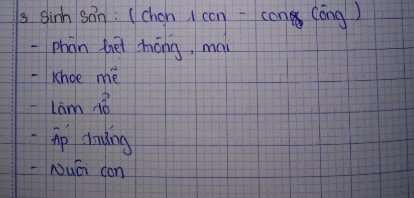
Phân biệt con đực và cái
- Công đực có kích thước khối lượng cơ thể to hơn con cái.
- Về bộ lông ở sau lưng công thì bộ lông của công đực dài và sặc sỡ hơn còn con cái thì đơn giản.
- Chân và cựa của công đực dài và nhọn của công cái ngắn và cùn.
- Trên đầu của công đực thường có màu xanh dương còn con cái màu nâu.
Khoe mẽ
- Ở công đực chúng sù lông nên khoe mẽ chủ yếu để tán tỉnh con cái.
- Còn công cái khi khoe mẽ nông nên thường là để bảo vệ trứng khỏi kẻ thù và chống lại con công khác cướp bạn tình.
Ấp trứng
- Chim đực không tham gia.
- Và con cái đảm nhận mọi trách nhiệm này và thời gian ấp trứng là 26-27 ngày và cách ấp trứng cũng kha khá dống 1 số loài chim.
Nuôi con
- Cũng chỉ chim cái nuôi con và với những ngày đầu cho con non ăn bằng cách dùng đầu và mỏ để dẫn sữa diều vào miệng con non.
- Khi sau thời kì con non chim con bắt đầu được chim công mẹ cho ăn thức ăn khác.
1)
a. Xét tg ABC cân tại A có AC=AB; gACB = g ABC.
Xét tg ACN và tg ABM có:
CN=BM (gt)
AC=AB
gACB=gABC
=> tg ACN = tg ABM (cgc)
=> AN=AM (2 cạnh tg ứng)
H là trung điểm BC nên AH là đường trung tuyến của tg ABC
Mak tg ABC cân => H cũng là đường cao của tg ABC => AH ⊥ BC
b. Vì H là trung đ của BC nên CH=HB=BC/2= 3cm
Áp dụng định lý Py ta go vào tg AHB có:
AB^2=AH^2+HB^2
AH^2= AB^2 - HB^2
AH^2= 5^2 - 3^2 = 16 cm
=> AH= 4 cm
c. Xét tg AMN và tg KMB có:
AM=KM (gt)
MN=BM (gt)
gHMA=gKMB (đối đỉnh)
=> tg AMN = tg KMB (cgc)
d. tg AMN = tg KMB => gMAN=gMKB
=> AN=KB=Am
Mà AB>AM (quan hệ giữ đường xiêng và hình chiếu) nên AB>BK
=> gBKA> gBAK
=> gMAN>gBAM
Bạn tham khảo :
Quê hương tôi không đẹp nên thơ những cũng đủ để tự hào mà nói rằng được thả diều mỗi chiều trên đê quả là tuyệt. Những tia nắng cuối cùng trong ngày còn xót lại cũng là lúc lũ trẻ chúng tôi kéo nhau ra bãi cát chân đê chơi. Từng làn gió mát phả trong không khí đưa những chiếc diều bay xa và bay cao. Nó gửi gắm ước mơ về 1 tương lai tươi đẹp của bọn trẻ thôn quê. Thêm vào đó con sông Hồng quang năm mải miết chảy bồi đắp phù xa cho 2 hàng cây tỏa bóng soi mình xuống mặt nước khiến cảnh vật trở nên hữu tình. Đứng ngắm hoàng hôn đang dần tắt, ánh hồng đang dần mất đi cảm giác tiếc nuối lạ kì. Chao ôi! Một ngày sôi động, ồn ã đã kết thúc.
(mik ko cần bạn k nhé !)
Chúc bạn học tốt !
ham khảo 5
Xuân! Xuân đã về-mùa của ước mơ, mùa của sức sống, khát khao đã về rồi. Trong vườn, cây cối bỏ đi cái áo khoác mà đã mang suốt mùa đông lạnh lẽo để thay vào đó là bộ quần áo mới tràn đầy những lá non, lộc biếc. Hoa khoe sắc, lộng lẫy trước nắng xuân. Trong các vòm cây, kẽ lá, những chú chim sơn ca cất vang lên bản nhạc chào xuân, rộn rã. Chỉ mới có vài hôm trước, mọi vật còn ủ rũ trong mùa đông mà giờ đã xanh tốt, tươi vui lạ thường. Trên nền trời, cánh én chao liệng vu vơ, từng đám mây bông trắng xốp nhẹ nhàng lững thững trôi, vui mừng. Ôi! thật là đẹp. Tất cả thật là đẹp.
 giúp mình với mình đang cần gấp mai phải nộp rồi ạ
 Bn tham khảo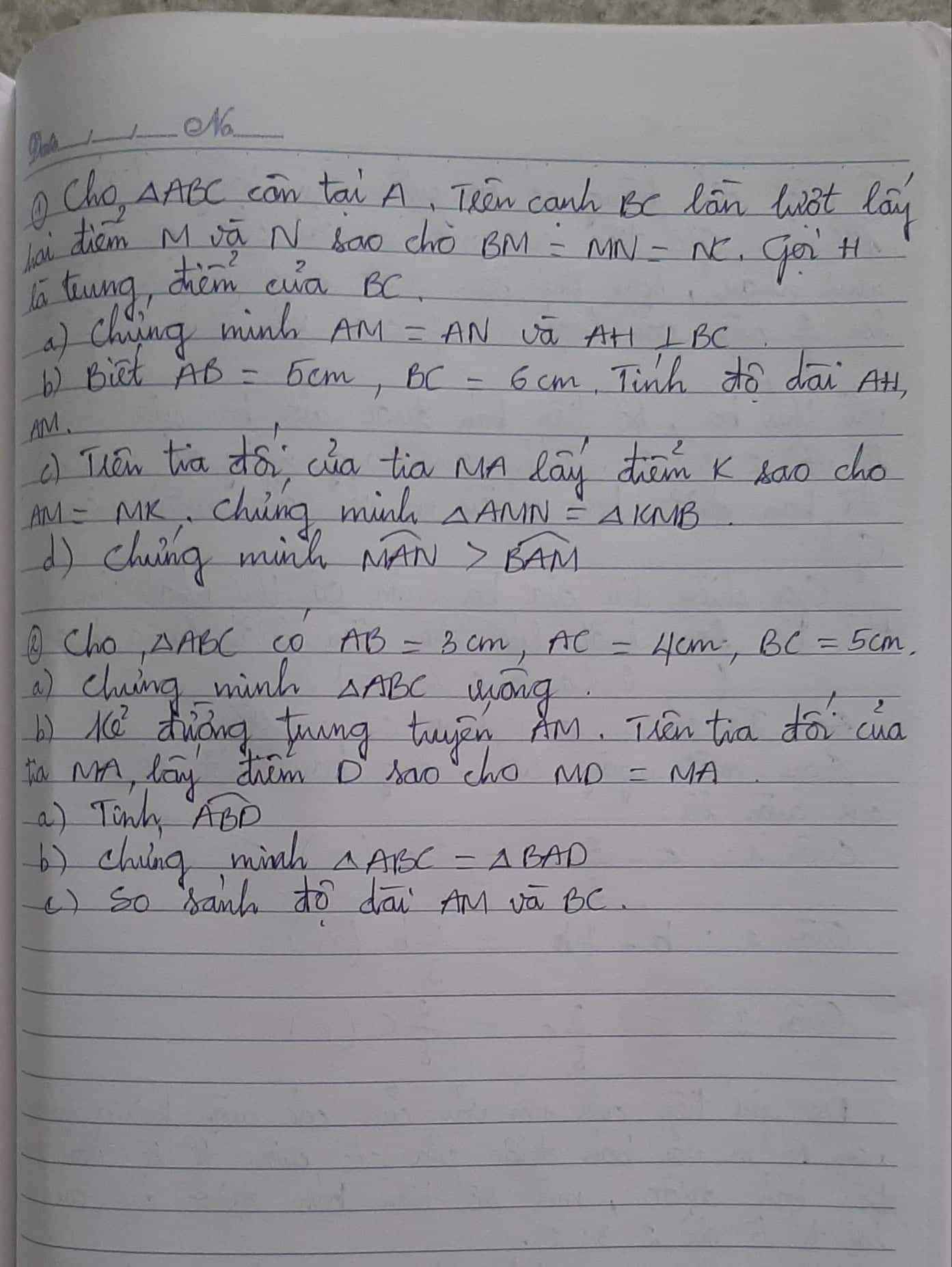

Olm chào em, khi đăng câu hỏi lên diễn đàn Olm, em cần đăng đầy đủ nội dung và yêu cầu, để nhận được sự trợ giúp tốt nhất từ cộng đồng Olm em nhé. Cảm ơn em đã đồng hành cùng Olm. Chúc em học tập hiệu quả và vui vẻ cùng Olm.