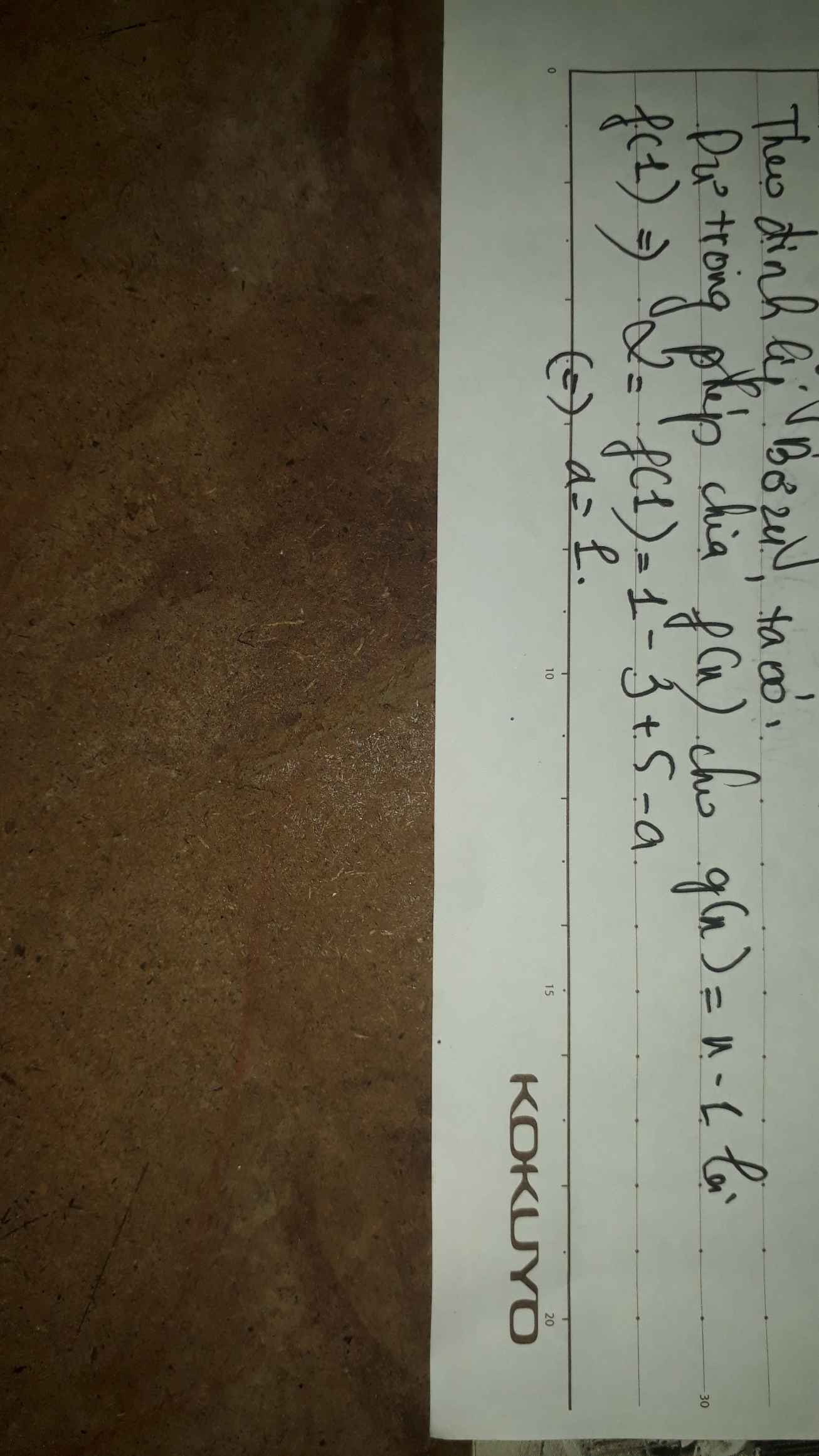
Cho : f(x) = 1+x+x9+x25+x49+x81
g(x) = x3-x. Tìm dư khi f(x) chia cho g(x)
Hãy nhập câu hỏi của bạn vào đây, nếu là tài khoản VIP, bạn sẽ được ưu tiên trả lời.

b: Ta có: f(x):g(x)
\(=\dfrac{x^3-2x^2+3x+a}{x+1}\)
\(=\dfrac{x^3+x^2-3x^2-3x+6x+6+a-6}{x+1}\)
\(=x^2-3x+6+\dfrac{a-6}{x+1}\)
Để f(x):g(x) là phép chia hết thì a-6=0
hay a=6
a: Thay a=3 vào f(x), ta được:
\(f\left(x\right)=x^3-2x^2+3x+3\)
\(\dfrac{f\left(x\right)}{g\left(x\right)}=\dfrac{x^3-2x^2+3x+3}{x+1}\)
\(=\dfrac{x^3+x^2-3x^2-3x+6x+6-3}{x+1}\)
\(=x^2-3x+6-\dfrac{3}{x+1}\)
d: Ta có: f(x):g(x)
\(=\dfrac{x^3-2x^2+3x+5}{x+1}\)
\(=\dfrac{x^3+x^2-3x^2-3x+6x+6-1}{x+1}\)
\(=x^2-3x+6+\dfrac{-1}{x+1}\)
Để f(x) chia hết cho g(x) thì \(x+1\in\left\{1;-1\right\}\)
hay \(x\in\left\{0;-2\right\}\)
câu 4: b, đề bài là tính giá trị của A tại x =-1/2;y=-1
Tk
Bài 2
a) F(x)-G(x)+H(x)= \(x^3-2x^2+3x+1-\left(x^3+x-1\right)+\left(2x^2-1\right)\)
= \(x^3-2x^2+3x+1-x^3-x+1+2x^2-1\)
= \(x^3-x^3-2x^2+2x^2+3x-x+1+1-1\)
= 2x + 1
b) 2x + 1 = 0
2x = -1
x=\(\dfrac{-1}{2}\)
Đặt \(A\left(x\right)=h\left(x\right)\cdot g\left(x\right)\)
\(=\left(x-2\right)\left(x^2+2\right)\)
\(=x^3+2x-2x^2-4=x^3-2x^2+2x-4\)
=>A(x) có bậc là 3
=>Đa thức dư khi F(x) chia cho A(x) sẽ có bậc tối đa là 2
Gọi đa thức dư đó có dạng là \(B\left(x\right)=ax^2+bx+c\) , gọi đa thức thương có dạng là \(Q\left(x\right)\)
Do đó, ta có: \(f\left(x\right)=Q\left(x\right)\left(x-2\right)\left(x^2+2\right)+ax^2+bx+c\)
f(x) chia x-2 dư 21
=>f(2)=21
Thay x=2 vào \(f\left(x\right)=Q\left(x\right)\left(x-2\right)\left(x^2+2\right)+ax^2+bx+c\) , ta được:
\(f\left(2\right)=q\left(2\right)\left(2-2\right)\left(x^2+2\right)+a\cdot2^2+b\cdot2+c\)
=>4a+2b+c=21
\(f\left(x\right)=Q\left(x\right)\left(x-2\right)\left(x^2+2\right)+ax^2+bx+c\)
\(=Q\left(x\right)\left(x-2\right)\left(x^2+2\right)+ax^2+2a+bx+c-2a\)
\(=\left(x^2+2\right)\left\lbrack Q\left(x\right)\left(x-2\right)+a\right\rbrack+bx+c-2a\)
f(x) chia \(x^2+2\) dư 2x-1 nên bx+c-2a=2x-1
=>b=2 và c-2a=-1
4a+2b+c=21
=>4a+4+c=21
=>4a+c=17
mà c-2a=-1
nên 4a+c-c+2a=17+1
=>6a=18
=>a=3
c-2a=-1
=>2a=c+1
=>c+1=6
=>c=5
Vậy: Đa thức dư là \(B\left(x\right)=3x^2+2x+5\)
f(x) chia \(x^2+2\) dư 2x-1
\(a,f\left(x\right):g\left(x\right)=\left(3x^4+9x^3+7x+2\right):\left(x+3\right)\\ =\left[3x^3\left(x+3\right)+7\left(x+3\right)-19\right]:\left(x+3\right)\\ =\left[\left(3x^3+7\right)\left(x+3\right)-19\right]:\left(x+3\right)\\ =3x^3+7.dư.19\)
\(c,\) Để \(k\left(x\right)⋮g\left(x\right)\Leftrightarrow-x^3-5x+2m=\left(x+3\right)\cdot a\left(x\right)\)
Thay \(x=-3\)
\(\Leftrightarrow-\left(-3\right)^3-5\left(-3\right)+2m=0\\ \Leftrightarrow27+15+2m=0\\ \Leftrightarrow2m=-42\\ \Leftrightarrow m=-21\)
`a,f(x)-g(x)+h(x)`
`=x^3-2x^2+3x+1-(x^3+x-1)+2x^2-1`
`=(x^3-x^3)+(2x^2-2x^2)+3x+1+1-1`
`=0+0+3x+1`
`=3x+1`
`b,f(x)-g(x)+h(x)=0`
`=>3x+1=0`
`=>x=-1/3`