

K
Khách
Hãy nhập câu hỏi của bạn vào đây, nếu là tài khoản VIP, bạn sẽ được ưu tiên trả lời.
Các câu hỏi dưới đây có thể giống với câu hỏi trên
BS
0
CM
8 tháng 9 2017
Đáp án C.
Gắn hệ trục tọa độ Oxyz, với O(0;0;0) là trung điểm của AB => OC= 3
Khi đó




⇒ x 2 + ( y + 1 ) 2 + z 2 + x 2 + ( y - 1 ) 2 + z 2 + 2 ( x - 3 ) 2 + 2 y 2 + 2 z 2 = 12


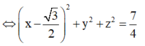
Vậy tập hợp các điểm M là một mặt cầu có bán kính
R
=
7
2
3 tháng 3 2016
Đối với cả ba nguyên hàm đã cho, ta sẽ áp dụng liên tiếp hai làn lấy nguyên hàm từng phần và trong hai lần việc chọn hàm \(u=u\left(x\right)\) là tùy ý ( còn \(dv\) là phần còn lại của biểu thức dưới dấu nguyên hàm. Sau phép lấy nguyên hàm từng phần kép đó ta sẽ thu được một phương trình bậc nhất với ẩn là nguyên hàm cần tìm
a) Đặt \(u=e^{2x}\) ,\(dv=\sin3xdx\)
Từ đó \(du=2e^{2x}dx\) , \(v=\int\sin3xdx=-\frac{1}{3}\cos3xdx\) Do đó :
\(I_1=-\frac{1}{3}e^{2x}\cos3x+\frac{2}{3}\int e^{2x}\cos3xdx\)
\(=-\frac{1}{3}e^{2x}\cos3x+\frac{2}{3}.I'_1\)\(I'_1=\int e^{2x}\cos3xdx\)
Ta áp dụng công thức lấy nguyên hàm từng phần
Đặt \(u=e^{2x}\) ; \(dv=\cos3xdx\) Khi đó \(du=2^{2x}dx\); \(v=\frac{1}{3}\sin2x\)
Do đó \(I'_1=\frac{1}{3}e^{2x}\sin3x-\frac{2}{3}\int e^{2x}\sin3xdx\) Như vậy :
\(I_1=-\frac{1}{3}e^{2x}\cos3x+\frac{2}{9}e^{2x}\sin3x-\frac{4}{9}\int e^{2x}\sin3xdx\)
\(I_1=\int e^{2x}\sin3xdx\)
Tức là \(I_1=-\frac{1}{3}e^{2x}\cos3x+\frac{2}{9}\sin3x-\frac{4}{9}I_1\)
Ta có \(I_1=\frac{3}{13}e^{2x}\left(\frac{2}{3}\sin3x-\cos3x\right)+C\)
3 tháng 3 2016
b) Đặt \(u=e^{-x}\) ; \(dv=\cos\frac{x}{2}dx\)
Từ đó :
\(du=-e^{-x}dx\) ; \(v=\int\cos\frac{x}{2}dx=2\int\cos\frac{x}{2}d\left(\frac{x}{2}\right)=2\sin\frac{x}{2}\)
Do đó :
\(I_2=2e^{-x}\sin\frac{x}{2}+2\int e^{-x}\sin\frac{x}{2}dx\) (b)
\(\int e^{-x}\sin\frac{x}{2}dx=I'_2\)
Ta cần tính \(I'_2\) Đặt \(u=e^{-x}\) ; \(dv=\sin\frac{x}{2}dx\)
Từ đó :
\(du=-e^{-x}dx\) ; \(v=\int\sin\frac{x}{2}dx=-2\cos\frac{x}{2}\)
Do đó :
\(I'_2=-2e^{-x}\cos\frac{x}{2}-2\int e^{-x}\cos\frac{x}{2}dx\)
\(=-2e^{-x}\cos\frac{x}{2}-2I_2\)
Thế \(I'_2\) vào (b) ta thu được phương trình bậc nhất với ẩn là \(I_2\)
\(I_2=2e^{-x}\sin\frac{x}{2}+2\left[-2e^{-x}\cos\frac{x}{2}-2I_2\right]\)
hay là
\(5I_2=2e^{-x}\sin\frac{x}{2}-4e^{-x}\cos\frac{x}{2}\) \(\Rightarrow\) \(I_2=\frac{2}{5}e^{-x}\left(\sin\frac{x}{2}-2\cos\frac{x}{2}\right)+C\)
21 tháng 3 2019
Nhìn 2 vế của hàm số thì có vẻ ta cần phân tích biểu thức vế trái về dạng \(\left[f\left(x\right).u\left(x\right)\right]'=f\left(x\right).u'\left(x\right)+u\left(x\right).f'\left(x\right)\), ta cần tìm thằng \(u\left(x\right)\) này
Biến đổi 1 chút xíu: \(\frac{\left[f\left(x\right).u\left(x\right)\right]'}{u\left(x\right)}=\frac{u'\left(x\right)}{u\left(x\right)}f\left(x\right)+f'\left(x\right)\) (1) hay vào bài toán:
\(\left(\frac{x+2}{x+1}\right)f\left(x\right)+f'\left(x\right)=\frac{e^x}{x+1}\) (2)
Nhìn (1) và (2) thì rõ ràng ta thấy \(\frac{u'\left(x\right)}{u\left(x\right)}=\frac{x+2}{x+1}=1+\frac{1}{x+1}\)
Lấy nguyên hàm 2 vế:
\(ln\left(u\left(x\right)\right)=\int\left(1+\frac{1}{x+1}\right)dx=x+ln\left(x+1\right)\)
\(\Rightarrow u\left(x\right)=e^{x+ln\left(x+1\right)}=e^x.e^{ln\left(x+1\right)}=e^x.\left(x+1\right)\)
Vậy ta đã tìm xong hàm \(u\left(x\right)\)
Vế trái bây giờ cần biến đổi về dạng:
\(\left[f\left(x\right).e^x\left(x+1\right)\right]'=e^x\left(x+2\right).f\left(x\right)+f'\left(x\right).e^x\left(x+1\right).f'\left(x\right)\)
Để tạo thành điều này, ta cần nhân \(e^x\) vào 2 vế của biểu thức ban đầu:
\(e^x\left(x+2\right)f\left(x\right)+e^x\left(x+1\right)f'\left(x\right)=e^{2x}\)
\(\Leftrightarrow\left[f\left(x\right).e^x.\left(x+1\right)\right]'=e^{2x}\)
Lấy nguyên hàm 2 vế:
\(f\left(x\right).e^x\left(x+1\right)=\int e^{2x}dx=\frac{1}{2}e^{2x}+C\)
Do \(f\left(0\right)=\frac{1}{2}\Rightarrow f\left(0\right).e^0=\frac{1}{2}e^0+C\Rightarrow C=0\)
Vậy \(f\left(x\right).e^x\left(x+1\right)=\frac{1}{2}e^{2x}\Rightarrow f\left(x\right)=\frac{1}{2}\frac{e^{2x}}{e^x\left(x+1\right)}=\frac{e^x}{2\left(x+1\right)}\)
\(\Rightarrow f\left(2\right)=\frac{e^2}{2\left(2+1\right)}=\frac{e^2}{6}\)
20 tháng 2 2019
4 câu 1,3,4,5 giống nhau, mình làm 1 câu và bạn dựa vào đó tự xử lý mấy câu còn lại nhé
1/ \(I=\int sin2x.e^{3x}dx\) \(\Rightarrow\left\{{}\begin{matrix}u=sin2x\\dv=e^{3x}dx\end{matrix}\right.\) \(\Rightarrow\left\{{}\begin{matrix}du=2cos2x.dx\\v=\dfrac{1}{3}e^{3x}\end{matrix}\right.\)
\(\Rightarrow I=\dfrac{1}{3}sin2x.e^{3x}-\dfrac{2}{3}\int cos2x.e^{3x}dx=\dfrac{1}{3}sin2x.e^{3x}-\dfrac{2}{3}I_1\)
Xét \(I_1=\int cos2x.e^{3x}dx\) \(\Rightarrow\left\{{}\begin{matrix}u=cos2x\\dv=e^{3x}dx\end{matrix}\right.\) \(\Rightarrow\left\{{}\begin{matrix}du=-2sin2xdx\\v=\dfrac{1}{3}e^{3x}\end{matrix}\right.\)
\(\Rightarrow I_1=\dfrac{1}{3}cos2x.e^{3x}+\dfrac{2}{3}\int sin2x.e^{3x}dx=\dfrac{1}{3}cos2x.e^{3x}+\dfrac{2}{3}I\)
\(\Rightarrow I=\dfrac{1}{3}sin2x.e^{3x}-\dfrac{2}{3}\left(\dfrac{1}{3}cos2x.e^{3x}+\dfrac{2}{3}I\right)\)
\(\Rightarrow\dfrac{13}{9}I=\dfrac{1}{9}e^{3x}\left(3sin2x-2cos2x\right)\)
\(\Rightarrow I=\dfrac{1}{13}e^{3x}\left(3sin2x-2cos2x\right)+C\)
3/ \(\int e^x\left(\dfrac{1+cos2x}{2}\right)dx=\dfrac{1}{2}\int e^xdx+\dfrac{1}{2}\int cos2x.e^xdx=\dfrac{e^x}{2}+\dfrac{1}{2}I_1\)
\(I_1\) có cách tính y hệt như bài 1, bạn nguyên hàm từng phần 2 lần là xong
4/ Cũng hạ bậc tương tự câu trên và xử lý
5/ \(I=\int e^{-x}\left(\dfrac{cos3x+3cosx}{4}\right)dx=\dfrac{1}{4}\int e^{-x}\left(cos3x+3cosx\right)dx\)
\(\Rightarrow I=\dfrac{1}{4}\int e^{-x}cos3x.dx+\dfrac{3}{4}\int e^{-x}cosx.dx=I_1+I_2\)
Dùng phương pháp tương tự bài 1, lần lượt tính \(I_1\) và \(I_2\) rồi cộng vào
2/\(I=\int\dfrac{x^4}{\left(x^2-1\right)^2}dx=\int\left(1+\dfrac{2x^2-1}{\left(x^2-1\right)^2}\right)dx=\int\left(1+\dfrac{2}{x^2-1}+\dfrac{1}{\left(x^2-1\right)^2}\right)dx\)
\(=\int\left(1+\dfrac{1}{x-1}-\dfrac{1}{x+1}+\dfrac{1}{4}\left(\dfrac{1}{x-1}-\dfrac{1}{x+1}\right)^2\right)dx\)
\(=\int\left(1+\dfrac{1}{x-1}-\dfrac{1}{x+1}+\dfrac{1}{4}\left(\dfrac{1}{\left(x-1\right)^2}+\dfrac{1}{\left(x+1\right)^2}+\dfrac{1}{x+1}-\dfrac{1}{x-1}\right)\right)dx\)
\(=\int\left(1+\dfrac{3}{4}\left(\dfrac{1}{x-1}-\dfrac{1}{x+1}\right)+\dfrac{1}{4}\dfrac{1}{\left(x+1\right)^2}+\dfrac{1}{4}\dfrac{1}{\left(x-1\right)^2}\right)dx\)
\(=x+\dfrac{3}{4}ln\left|\dfrac{x-1}{x+1}\right|-\dfrac{1}{4\left(x+1\right)}-\dfrac{1}{4\left(x-1\right)}+C\)
\(=x+\dfrac{3}{4}ln\left|\dfrac{x-1}{x+1}\right|-\dfrac{x}{2\left(x^2-1\right)}+C\)
HT
12 tháng 8 2019
thầy e cx cho câu giống câu 2 kia, e tắc luôn ạ, may mà anh lm r :))
AH
Akai Haruma
Giáo viên
9 tháng 7 2017
a)
Đặt \(u=\sqrt{x-3}\Rightarrow x=u^2+3\)
\(I_1=\int (2x-3)\sqrt{x-3}dx=\int (2u^2+3)ud(u^2+3)=2\int (2u^2+3)u^2du\)
\(\Leftrightarrow I_1=4\int u^4du+6\int u^2du=\frac{4u^5}{5}+2u^3+c\)
b)
\(I_2=\int \frac{xdx}{\sqrt{(x^2+1)^3}}=\frac{1}{2}\int \frac{d(x^2+1)}{\sqrt{(x^2+1)^2}}\)
Đặt \(u=\sqrt{x^2+1}\). Khi đó:
\(I_2=\frac{1}{2}\int \frac{d(u^2)}{u^3}=\int \frac{udu}{u^3}=\int \frac{du}{u^2}=\frac{-1}{u}+c\)
c)
\(I_3=\int \frac{e^xdx}{e^x+e^{-x}}=\int \frac{e^{2x}dx}{e^{2x}+1}=\frac{1}{2}\int\frac{d(e^{2x}+1)}{e^{2x}+1}\)
\(\Leftrightarrow I_3=\frac{1}{3}\ln |e^{2x}+1|+c=\frac{1}{2}\ln|u|+c\)
AH
Akai Haruma
Giáo viên
10 tháng 7 2017
d)
\(I_4=\int \frac{dx}{\sin x-\sin a}=\int \frac{dx}{2\cos \left ( \frac{x+a}{2} \right )\sin \left ( \frac{x-a}{2} \right )}\)
\(\Leftrightarrow I_4=\frac{1}{\cos a}\int \frac{\cos \left ( \frac{x+a}{2}-\frac{x-a}{2} \right )dx}{2\cos \left ( \frac{x+a}{2} \right )\sin \left ( \frac{x-a}{2} \right )}=\frac{1}{\cos a}\int \frac{\cos \left ( \frac{x-a}{2} \right )dx}{2\sin \left ( \frac{x-a}{2} \right )}+\frac{1}{\cos a}\int \frac{\sin \left ( \frac{x+a}{2} \right )dx}{2\cos \left ( \frac{x+a}{2} \right )}\)
\(\Leftrightarrow I_4=\frac{1}{\cos a}\left ( \ln |\sin \frac{x-a}{2}|-\ln |\cos \frac{x+a}{2}| \right )+c\)
e)
Đặt \(t=\sqrt{x}\Rightarrow x=t^2\)
\(I_5=\int t\sin td(t^2)=2\int t^2\sin tdt\)
Đặt \(\left\{\begin{matrix} u=t^2\\ dv=\sin tdt\end{matrix}\right.\Rightarrow \left\{\begin{matrix} du=2tdt\\ v=-\cos t\end{matrix}\right.\)
\(\Rightarrow I_5=-2t^2\cos t+4\int t\cos tdt\)
Tiếp tục nguyên hàm từng phần \(\Rightarrow \int t\cos tdt=t\sin t+\cos t+c\)
\(\Rightarrow I_5=-2t^2\cos t+4t\sin t+4\cos t+c\)
Về cơ bản, E = mc² là đúng, nhưng để chính xác hơn, cần hiểu ngữ cảnh:
\(E^{2} = \left(\right. m c^{2} \left.\right)^{2} + \left(\right. p c \left.\right)^{2}\)
với \(p\) là động lượng.
Nói một cách đơn giản: khối lượng có thể chuyển thành năng lượng và ngược lại, và E = mc² là công thức rút gọn trong trường hợp vật thể đứng yên.
bằng 2 nhưng cũng có thể bằng 1 vì 1 cái dép cộng 1 cái dép bằng 1 đôi dép =)
Hello